
Executive Summary: The Strategy Logic Chain Applied to Cities
Most competitive strategies fail from a break in the logic connecting their essential elements. Companies pursue innovation, lower costs, and moats, yet these initiatives often fail to reinforce one another.
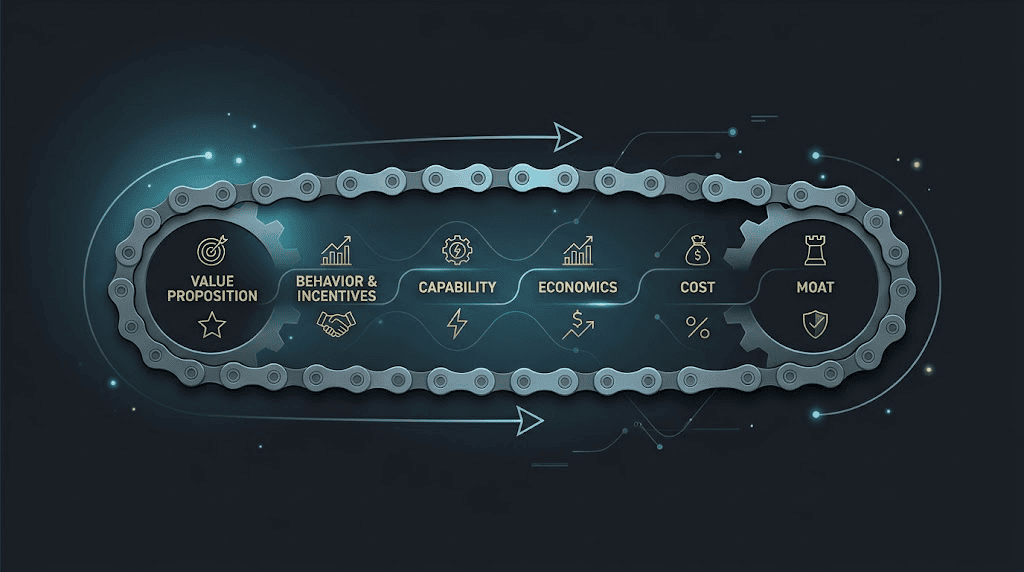
The Strategy Logic Chain addresses this disconnect through six interconnected links: Value Proposition → Consumer Behavior (& Incentives) → Capability → Economic Drivers → Cost → Moat.
To test whether this framework applies beyond the firm, I examined Shenzhen’s transformation from a 1980 border community into a US$557B tech metropolis.
Key Strategic Takeaways:
- Value Proposition: Advantage isn’t just about being cheaper. Shenzhen offered unique access to capital, international trade, and manufacturing networks through its proximity to Hong Kong.
- Behavior & Incentives: Intentions mean nothing if the operating environment penalizes the required behavior. Policy flexibility and market reforms aligned incentives to drive real enterprise action.
- Capability vs. Resources: Attracting factories is not the same as building an ecosystem. Shenzhen’s true strength lies in supplier concentration and rapid coordination between tooling experts, engineers, and assemblers.
- Economic Drivers: Capabilities matter only when connected to sufficient demand. Revenue growth can conceal weak underlying economics, strategy must connect industrial capacity directly to market scale and viable business models.
- Cost as System Productivity: True cost advantage goes beyond wages or land. Frictionless component sourcing, shorter lead times, and rapid prototyping lower the total system cost of delivering a product.
- Moats Are Outcomes, Not Starting Points: You cannot start strategy by declaring a moat. A defensible advantage is the cumulative result of getting all prior links right.
Three Questions for Leaders:
- For the Board: Are we committing capital before testing our critical assumptions?
- For the CEO: Does our operating model and incentive structure actually support our stated strategy, or is there a broken link?
- For the Business Owner: Is our advantage built on temporary market conditions, or are we developing capabilities that compound over time?
Bottom Line: Before fixing symptoms, find the broken link. A moat cannot rescue a broken business model, and a compelling vision cannot overcome incentives that reward the wrong behavior.
***
The Article:
The Problem: Breaks in Strategy Logic
Many companies want a competitive advantage. Fewer understand the chain of decisions required to build one.
They invest in innovation, pursue lower costs, differentiate their products and search for a moat that competitors cannot easily cross. Yet these initiatives often fail to reinforce one another. The product may be attractive, but the economics do not work. The business may grow, but its capabilities cannot keep pace. The company may enjoy an early advantage without developing the strengths needed to sustain it.
The problem is often not the absence of strategy. It is a break in the logic connecting its essential elements.
This is the thinking behind the Strategy Logic Chain, a framework I have written about and applied in corporate settings. It examines six connected links:
- Value Proposition,
- Consumer Behavior
- Capability
- Economic Drivers
- Cost, and
- Moat.
Recently, I found myself asking a different question: Could this framework also help us understand the development of a city?
My answer led me to Shenzhen.
When I returned from a self-funded study trip to Shanghai in July 2026, I reflected on Shenzhen, another Chinese city whose transformation has reshaped the global technology and manufacturing landscape.
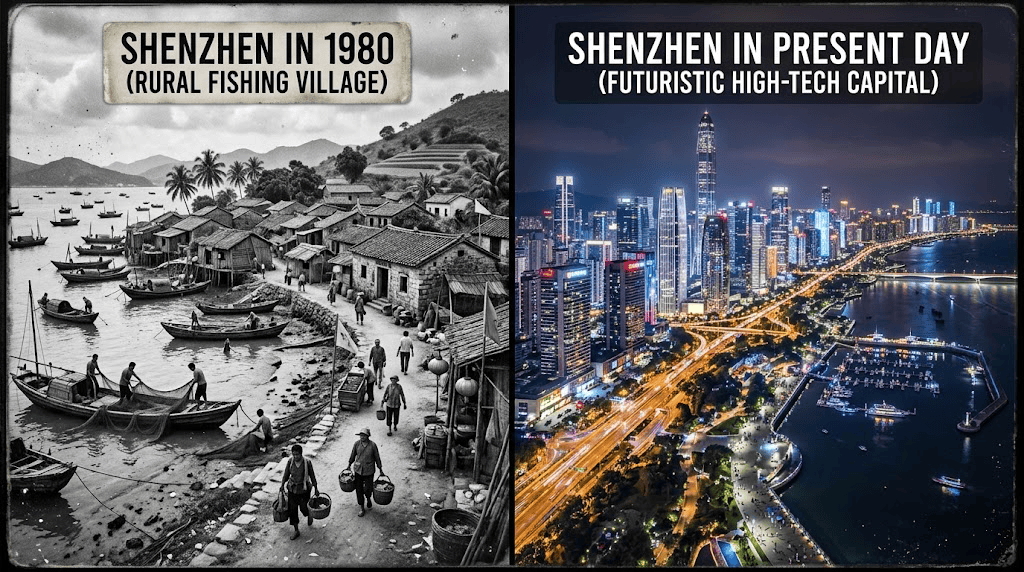
I first visited Shenzhen in 1984, during a brief side trip from Hong Kong. It was then a relatively undeveloped border community. Today, it is a major technology and manufacturing center, home to companies such as Huawei, Tencent, DJI and BYD.
The scale of Shenzhen’s transformation is remarkable. According to the city’s official 2025 statistical communique, Shenzhen’s gross domestic product reached RMB 3.873 trillion, equivalent to approximately US$557 billion, with a year-end resident population of 18.25 million and a real GDP growth rate of 5.5%.
To grasp the sheer concentration of this economic engine, consider its global weight: a single sub-provincial city of roughly 2,000 square kilometers generates an economic output larger than the entire national GDP of ASEAN nations like the Philippines (US$502B), Vietnam(US542 billion), and Malaysia (US$547B), while rivaling economic heavy weights like Thailand (US$599B) and Singapore (US$668B).
Yet, when designated in 1980 as one of China’s original four Special Economic Zones (SEZs), Shenzhen was merely a quiet agricultural and fishing hub of fewer than 30,000 residents. It was a bold economic experiment whose eventual success was far from guaranteed, a testament to what happens when policy, capital, and organizational capabilities align with absolute causal discipline.
What interests me is not simply how much the city has grown. It is how its value proposition, behavior and incentives, capabilities, economics and cost advantages developed in ways that helped create a formidable industrial ecosystem.
I am not suggesting that Shenzhen’s policymakers consciously followed my Strategy Logic Chain. Nor am I claiming that six links can fully explain the city’s rise. Its development involved political decisions, institutional reforms, migration, foreign investment, global trade and circumstances that cannot be reduced to a single framework.
My purpose is different: to apply a framework developed for corporate strategy to a city, and to examine what this change in perspective reveals.
Can the same strategic logic that helps explain a company’s competitive advantage also help us understand how a city builds an economic ecosystem that is difficult to replicate?
From Corporate Strategy to City Strategy
The Strategy Logic Chain consists of six connected links:
Value Proposition → Behavior & Incentives → Capability → Economics → Cost → Moat
In a corporation, the questions are straightforward.
- What value are we creating?
- What behavior does our strategy require?
- What capabilities must we build?
- Do the economics work?
- Can we deliver competitively?
- What makes our advantage difficult to copy?
Applied to a city, the questions become broader.
- Value Proposition: Why should businesses, investors, workers and entrepreneurs choose this location?
- Behavior & Incentives: What encourages them to invest, innovate, work and build businesses there?
- Capability: What industrial, technological and institutional capabilities must the city develop?
- Economics: Can these capabilities connect to sufficient demand and sustain productive economic activity?
- Cost: Can the city support competitive productivity and efficient operations?
- Moat: What accumulated advantages make its economic ecosystem difficult for competing locations to reproduce?
The framework provides a way to examine the relationships among these elements. It does not establish historical causation by itself.
There is also an important distinction between a corporation and a city. A corporation can organize its strategy around commercial objectives. A city must consider employment, housing, environmental quality, public welfare and the distribution of economic opportunity. A successful economic ecosystem does not automatically produce good outcomes for every resident.
With these qualifications, Shenzhen offers a useful case through which to examine the Strategy Logic Chain beyond its original corporate setting.
1. Value Proposition: Why Shenzhen?
In 1980, China designated Shenzhen as one of its original Special Economic Zones (SEZ). Rather than requiring the entire country to adopt new economic arrangements at once, the SEZ approach created space for experimentation.
Shenzhen’s proposition combined greater economic flexibility and opportunities for investment with an important geographic advantage: proximity to Hong Kong, then a major international commercial and financial center.
This connection mattered. Hong Kong provided access to foreign capital, international markets, established business relationships and manufacturing connections. Shenzhen could offer a location in mainland China from which businesses could participate in these networks.
The proposition was not simply that Shenzhen would be cheaper. It was that businesses could gain access to a combination of opportunities that was difficult to obtain elsewhere under the prevailing conditions.
This distinction matters in corporate strategy, too. A company does not create a compelling value proposition by declaring its product innovative or its service superior. Customers must have a reason to choose it, and the value must matter enough to influence their decisions.
Shenzhen’s proposition also evolved. As the city developed its infrastructure, workforce and industrial ecosystem, it became attractive for reasons beyond its original policy advantages.

2. Behavior & Incentives: Turning Opportunity into Action
An attractive proposition creates an opportunity. Incentives help turn that opportunity into behavior.
China’s reform era placed greater emphasis on experimentation and practical economic results. Shenzhen’s special status allowed new economic arrangements to be tested, while investment opportunities created reasons for businesses and workers to participate.
Research by the World Bank identifies land-use reforms, infrastructure investment, labor-market changes and links to Hong Kong as important elements of Shenzhen’s development. These factors helped create conditions in which commercial activity could expand.
The significance lies in their interaction. Policy flexibility alone would not have been enough if businesses lacked infrastructure or market access. Infrastructure alone would not have guaranteed investment if the surrounding economic arrangements discouraged participation.
The same problem appears inside companies. Management may declare innovation a priority but penalize employees whenever an experiment fails. It may demand collaboration while rewarding executives exclusively for individual departmental results. The stated strategy points in one direction; the incentives point in another.
In both a company and a city, intentions are less revealing than the behavior the operating environment actually encourages.
For a city, this means examining whether policies and institutions encourage productive investment and enterprise. For a corporation, it means examining whether targets, rewards and constraints support the desired behavior.
3. Capability: From Factories to an Ecosystem
Attracting factories is not the same as developing an industrial ecosystem.
Over time, Shenzhen and its surrounding manufacturing networks developed concentrations of component suppliers, tooling specialists, engineers, testing facilities, logistics providers, assemblers and technology firms.
The advantage lies not merely in the number of companies present, but in the relationships among them.
A manufacturer can source components, modify a design, adjust tooling, test a prototype and return to production without having to coordinate every activity across distant locations.
Specialized knowledge accumulates. Supplier relationships become established. Problems can be solved through repeated interaction.
The result can be a system that develops and produces goods more efficiently than a collection of disconnected businesses.
This is the difference between resources and capabilities. A company can purchase advanced equipment without developing the expertise to use it effectively. It can hire talented employees without building the processes that allow their knowledge to become organizational strength.
Likewise, a city can attract individual businesses without developing the connections that make an industrial ecosystem productive.
A competing location can build an industrial park or offer incentives. Reproducing accumulated expertise, supplier relationships and coordination is considerably harder.
4. Economics: Connecting Capability to Demand
Capabilities matter only when they create economic value.
Shenzhen’s early development benefited from foreign investment and export markets. China’s subsequent economic expansion created a much larger domestic market for manufactured goods and technology.
The city’s growth has continued. Its official 2025 statistical communique reports GDP of RMB 3.873 trillion, up 5.5% in real terms from the previous year. The services sector accounted for 62.5% of GDP, while the secondary sector, including manufacturing and construction, accounted for 37.4%.
The figures illustrate that Shenzhen is no longer simply a manufacturing base. It combines a substantial industrial sector with a large services economy, including finance, information technology and other business services.
The city’s economic evolution also reflects the importance of distinguishing growth from its underlying drivers. Shenzhen’s GDP rose from RMB 270 million in 1980 to RMB 3.680 trillion in 2024. Its municipal statistics bureau reports average annual real GDP growth of 18.8% over that period, measured at constant prices. The 1980 and 2024 GDP levels are nominal values; the reported growth rate adjusts for price changes.
These figures establish the scale of the transformation. They do not, by themselves, establish how much any particular policy or strategic mechanism contributed to the outcome.
For our purposes, the important question is how industrial capabilities connected to markets, investment and growing sources of demand.
The corporate equivalent is straightforward. A company can have talented people, excellent technology and a compelling product but still struggle if its market is too small or customers are unwilling to pay enough to support the business model.
Revenue growth can also conceal weak economics. Sales may increase while discounts, customer acquisition costs and capital requirements erode profitability.
A city presents a more complex case because economic output is only one measure of development. GDP does not independently tell us how benefits are distributed, whether growth is environmentally sustainable or whether living standards improve for all residents.
The economic link must therefore be assessed against the objectives being pursued.
5. Cost: The Productivity of the Whole System
Shenzhen’s industrial concentration helped reduce friction in sourcing components, coordinating production, adjusting designs and moving goods through established networks.
Companies could access specialized capabilities without building every function internally. Shorter development cycles, established supplier relationships and faster problem-solving could improve productivity and reduce the cost of delivering a product.
This is a broader conception of cost than wages or land prices.
Consider two manufacturers producing the same product. One pays less for labor but suffers from procurement delays, repeated design revisions and production errors. The other pays more for labor but benefits from reliable suppliers, faster engineering changes and shorter lead times.
The cheaper inputs do not necessarily produce the lower total cost.
For Shenzhen, the potential advantage came from the interaction of infrastructure, suppliers, logistics, expertise and manufacturing experience. A company could benefit from the productivity of the surrounding ecosystem rather than having to build every capability itself.
However, density is not an unconditional advantage. Rising wages, expensive land, congestion, environmental pressures and concentrated supply risks can erode its benefits.
The corporate lesson is similar. Cutting one expense may increase costs elsewhere. Reducing inventory may lower working capital but increase the risk of production interruptions.
Choosing the cheapest supplier may lead to higher defect rates and longer delays.
6. Moat: Why Is the Advantage Difficult to Replicate?
The final link is often where management tries to begin. It is where the Strategy Logic Chain leads.
Shenzhen’s accumulated industrial and technological capabilities create the potential for a reinforcing cycle. More companies attract specialized suppliers. More suppliers make it easier for new ventures to develop products. New ventures attract talent and capital, creating further opportunities.
Over time, the ecosystem can become more valuable because of what its participants collectively know and can accomplish.
This is the difference between having an advantage and having a defensible one.
A competitor can match a product feature, lower a price or purchase similar equipment. Reproducing decades of accumulated relationships, specialized expertise and coordinated capabilities is a different undertaking.
Yet a moat is never permanent. New technologies can change production economics. Competing locations can develop alternative ecosystems.
Geopolitical tensions can disrupt access to markets and critical inputs. Concentration can itself become a vulnerability.
For a city, sustaining the advantage requires continued adaptation across businesses, institutions, infrastructure and talent development. For a corporation, it requires continuing to improve the capabilities and relationships on which its competitive position depends.
The point is not that Shenzhen has become impossible to challenge. It is that accumulated capabilities and ecosystem relationships can make competition more difficult than a simple comparison of costs or individual assets would suggest.
The Real Test: What Happens When One Link Breaks?
Consider a company that develops a promising product. Customer research indicates strong demand, and the engineering team delivers an excellent prototype. Management approves a national launch.
But the company has not tested whether suppliers can meet the required volumes, whether distribution costs support the target price or whether sales incentives encourage profitable transactions.
The launch generates orders. Delivery delays frustrate customers, expedited shipping erodes margins and discounting undermines profitability.
The company did not necessarily choose the wrong product. It assumed that success in one part of the business would compensate for weaknesses elsewhere.
The Strategy Logic Chain provides a way to diagnose the problem. Was the value proposition validated? Were incentives aligned with the desired behavior? Did the company have the necessary capabilities? Were the economics viable? Could the operating system deliver at a competitive cost?
Each diagnosis suggests a different response.
More salespeople will not solve an unprofitable value proposition. More factories will not solve weak demand. More marketing will not correct incentives that reward the wrong behavior.
The same logic can be applied to a city. Attracting investment is insufficient if infrastructure, skills and institutions cannot support productive activity.
Building industrial capacity is insufficient if businesses cannot reach markets. Offering incentives is insufficient if economic activity does not develop into durable capabilities.
The framework does not prove why Shenzhen succeeded. It helps us ask more disciplined questions about the relationships among the factors involved.
Before fixing the symptoms, find the broken link.
What We Can, and Cannot, Learn from Shenzhen
Shenzhen’s transformation cannot be reduced to six variables.
Its development depended on a particular historical setting: China’s reform trajectory, proximity to Hong Kong, access to international markets, foreign investment, migration, infrastructure development and the expansion of the Chinese economy.
Other cities may lack some of these conditions. They may face different institutional constraints, labor markets, infrastructure requirements or geopolitical risks.
Nor should GDP be the sole measure of success. Economic growth can coexist with pressures involving housing affordability, congestion, environmental quality, inequality and the distribution of opportunity.
These qualifications matter because applying a corporate framework to a city is not the same as claiming that a city operates like a company. A city has multiple stakeholders, competing public objectives and social obligations that extend beyond economic competitiveness.
The transferable insight is more modest, and more useful.
The Strategy Logic Chain offers a way to examine whether the components of a development strategy reinforce one another. It helps identify questions about value creation, incentives, capabilities, economics, costs and accumulated advantages that might otherwise be considered separately.
It is an analytical lens, not a formula for replicating Shenzhen.
Copying a successful outcome is not the same as understanding the logic that helped produce it.
Applying the Strategy Logic Chain to Your Own Business
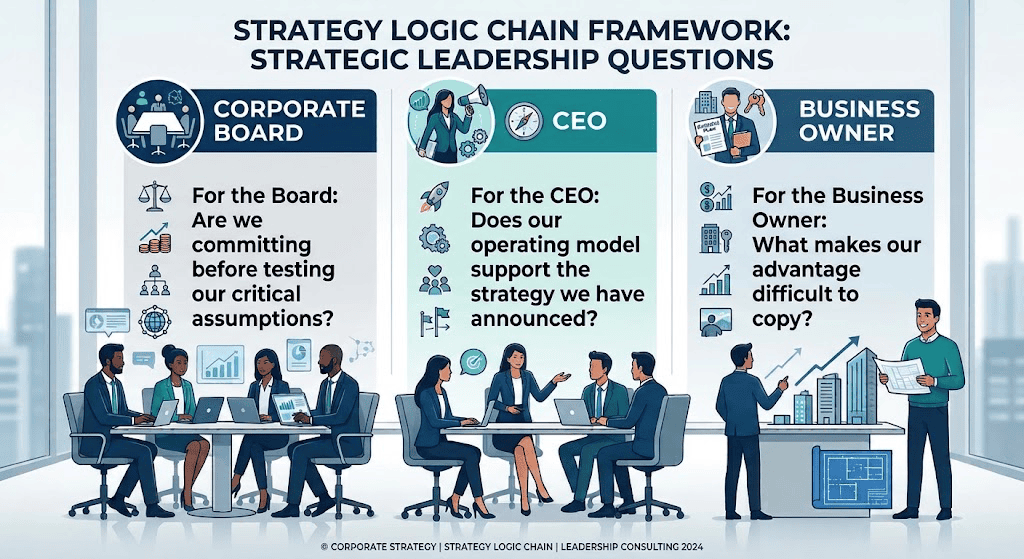
The Shenzhen case offers three questions for leaders.
For the Board: Are we committing capital before testing our critical assumptions?
Can management demonstrate that the value proposition works beyond a limited pilot? Have directors agreed on the evidence required to scale, the losses the company can tolerate and the conditions that would justify stopping?
For the CEO: Does our operating model support the strategy we have announced?
Do incentives encourage the required behavior? Can our people, technology, operations and suppliers deliver the promised value at the necessary quality, speed and cost? Where is the weakest link?
For the Business Owner: What makes our advantage difficult to copy?
Are we relying mainly on temporary price differences or favorable market conditions? Or are we building customer trust, specialized knowledge, supplier relationships and operating capabilities that improve through experience?
These questions should not be asked only when a strategy is approved. They should be revisited as the market changes and the business learns.
The Bigger Lesson
I applied the Strategy Logic Chain to Shenzhen because I wanted to test its usefulness beyond the corporate setting in which I have written about it.
The exercise reinforces an important distinction: strategy is not a collection of independent initiatives. It is a connected set of decisions whose logic must hold together.
Start with the problem. Identify the insight that changes how it should be approached. Make the key assumptions explicit. Test the value proposition. Align incentives with the required behavior. Build the necessary capabilities. Confirm that the economics work. Improve the cost structure. Then develop advantages that become harder to reproduce as the organization learns and grows.
And keep testing the logic. Customers change, competitors respond, technologies evolve and yesterday’s advantage can become tomorrow’s liability.
Too many companies begin with the moat. They declare that they will be innovative, customer-centric, low-cost or market-leading without establishing the decisions and capabilities required to make those ambitions real.
But a moat cannot compensate for a broken business model. Lower costs cannot rescue a product customers do not want. And a compelling vision cannot overcome incentives that reward the wrong behavior.
Competitive advantage is not the starting point of strategy. It is the cumulative result of getting the underlying decisions right.
Shenzhen offers a compelling case through which to examine that logic at the level of a city. The Strategy Logic Chain does not explain everything about Shenzhen, nor does it guarantee that another city can reproduce its success. It gives us a disciplined way to investigate how a system creates value, develops capabilities and builds advantages over time.
That is also how I believe corporate leaders should approach strategy: not by copying the visible success of others, but by understanding the logic beneath it and testing whether that logic holds in their own circumstances.
Before asking how to build a moat, ask whether the logic beneath it holds.
***
Josiah Go is the Chairman and Chief Innovation Strategist of Mansmith and Fielders, Inc., an entrepreneur, independent director, award-winning educator and bestselling author. His visits to Shanghai and Shenzhen were self-funded observation trips.
Note: Shenzhen’s 2025 statistical communique identifies the figures as preliminary. GDP growth rates are calculated at comparable prices, while GDP levels are reported at current prices. The Strategy Logic Chain is the author’s analytical lens for decoding and interpreting the historical evidence