

A few weeks ago, I noticed something while passing by a familiar spot. A milk tea shop that used to be there had closed down. In its place, a new one had opened. Same type of business. Same location. Same kind of customers passing through.
On the surface, it looked like a simple replacement—one business out, another in. But it made me pause a bit. Because this is something you tend to notice when you’ve been around businesses long enough. A company looks fine from the outside. Sometimes even growing. Sales are coming in. Targets are being met. Reports are acceptable. But inside, something feels slightly off. A bit more pressure. A bit less clarity. A kind of fatigue that is not immediately visible, but slowly accumulates.
Customers are not quite as satisfied as before. People are working harder, but not necessarily better. Margins are quietly not what they used to be. And nothing dramatic happens at first. That is usually how it begins.
The quiet problem with metrics
Most businesses today are not short on numbers. In fact, there is usually too much of it. Dashboards, reports, KPIs—everything is tracked. And because everything is measured, it often feels like everything is under control.
But measurement and understanding are not the same thing. Over time, it becomes possible to manage a business that looks organized on paper, while slowly drifting away from what actually matters.
How strategy is really supposed to work
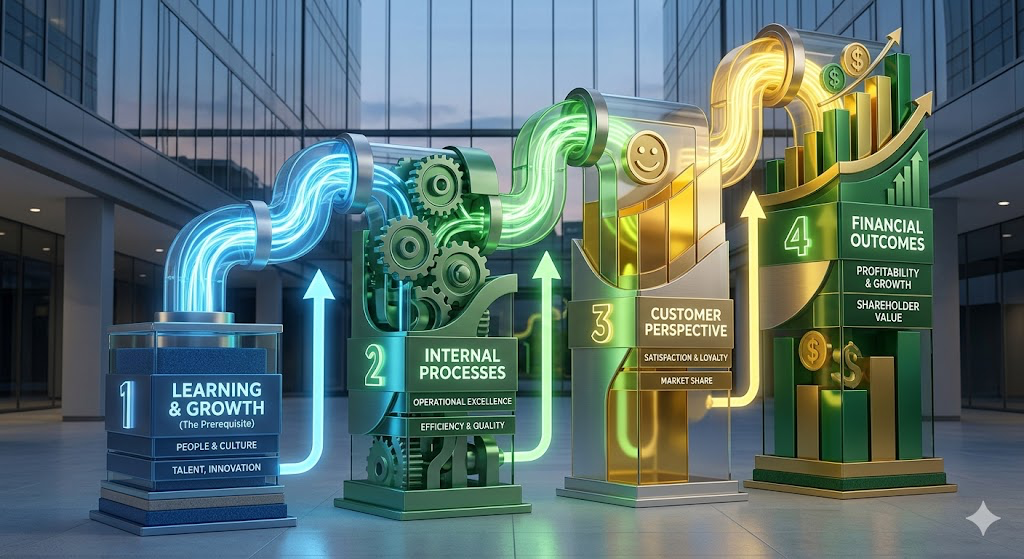
The Balanced Scorecard, developed by Robert Kaplan and David Norton, is often introduced as four perspectives: Financial, Customer, Internal processes, Learning and growth. Simple enough.
But the real idea was never merely about classification. It was about connection. Results do not come from one place alone, they come from how they are interconnected. Financial outcomes come from customers. Customers are shaped by internal processes. Processes are shaped by how people learn, adapt, and improve over time.
When this chain is clear, metrics have meaning. When it is not, metrics become isolated signals—useful, but incomplete.
When the business looks fine, but drift happens
Take the milk tea shop. The goal is simple: grow revenue. So the natural response is to push harder, this means more promotions, faster service, more aggressive selling. And at first, it works. Sales go up.
But after some time, something else begins to shift. Orders feel rushed. Mistakes become more common. Regular customers start to notice inconsistency. Some quietly stop coming back.
Nothing in the revenue line immediately reflects it. But something in the business has already changed.
In many cases, it does not come from one single decision. It comes from small, reasonable decisions that accumulate over time. Growth is important, so it gets measured. Efficiency is important, so it gets tracked. Customer satisfaction is equally important, so it is monitored. Everything looks right individually.
But without a clear sense of direction, these measures can start pulling in different directions.
At some point, what is being measured is not exactly aligned with what is being intended. Profit is the goal, but revenue becomes the focus. Loyalty is important, but transactions are counted more. Quality matters, but speed becomes the priority.
People eventually respond to what is measured, not necessarily what is intended.
And most metrics, by design, only tell you what has already happened. They are useful, but still reflections of the past. So when a problem finally shows up in the numbers, it often feels sudden, even if it has been building for some time. By then, decisions are already reactive.
When parts of the system move separately
There are also moments when different parts of the organization begin to optimize on their own. Finance focuses on cost. Operations focuses on output. Sales focuses on volume. Each one doing what is expected of them.
Individually, performance looks acceptable. But collectively, something feels less stable. Because the organization is no longer moving as one system.
When execution disconnects from measurement
There are situations where everything is being tracked properly, and reports are being reviewed regularly, but very little is actually changing. The numbers are there. The discussions are happening. But the underlying drivers are not really being worked on.
So results remain the same. Or shift without clear explanation. In many cases, it is not a lack of information. It is a lack of movement behind the information.
When discipline weakens slowly
Even well-designed systems begin to lose effectiveness when discipline becomes inconsistent. Metrics get adjusted too easily. Accountability becomes less clear over time. Reviews become routine instead of reflective.
And gradually, trust in the system weakens.
Once that happens, even good strategy struggles to hold.
A simple discipline
In practice, it often helps to keep things simple. Not too many measures. Not too many competing priorities. What matters more is whether the important relationships inside the business are understood, and whether people know what actually drives what.
Because strategy is not really about dashboards. It is about alignment. Between what you want. What you measure. And what people do every day. And how consumers should react.
Assumptions
There is a tendency in business to assume that if the numbers are good, then everything is fine. But sometimes, a business can be doing well in what it is measuring, while slowly drifting away from what it is trying to become.
So it may be worth asking, from time to time, not just whether the numbers are improving, but whether they are still pointing in the right direction.
And sometimes, what looks like progress on a metric is simply movement in the wrong direction.
***
Josiah Go is a business thought leader, bestselling author of 20 books in marketing and entrepreneurship, and the chair of Mansmith and Fielders Inc.