

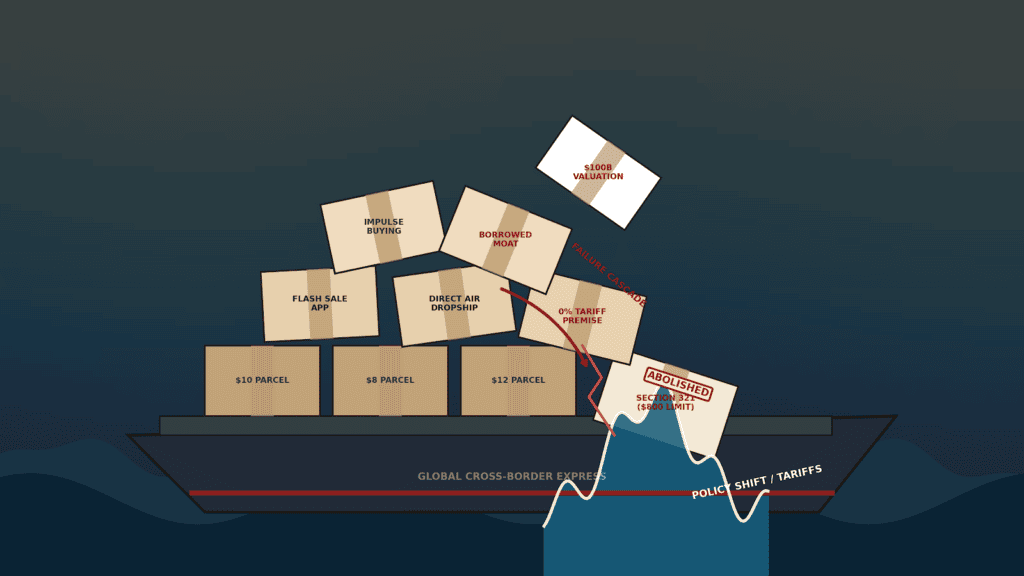
When news broke that the United States government moved to close the $800 de minimisthreshold, the tariff-free customs exemption long leveraged by Chinese cross-border platforms Shein and Temu to ship direct-to-consumer parcels via air freight, industry observers treated it as a sudden geopolitical shock. But from a strategic auditing perspective, this outcome was not a surprise. It was a structural load failure waiting for a trigger.
To evaluate why this model buckled, we must place it inside the PILA reasoning stack, our diagnostic operating system built on four sequential layers: Problem, Insight, Logic, and Assumptions.
Within PILA, logic is not mere narrative; it is an “If-Then” load-bearing structure. Most strategic failures do not begin in the market; they originate in unchecked assumptions sitting beneath the surface.
1. Value Proposition → 2. Consumer Behavior → 3. Capability → 4. Economic Drivers → 5. Cost Structure → 6. Moat
In our framework, strategy is an unbroken sequence of six causal links. If external forces or policy shifts snap a single link, the entire engine stalls, no matter how aggressive the marketing spend or how fast the digital algorithms run.
1. Mapping the Fracture: Where the Chain Snapped
To audit Shein and Temu, we must trace how their strategy logic chain was originally constructed—and precisely where the structural link fractured under regulatory pressure.
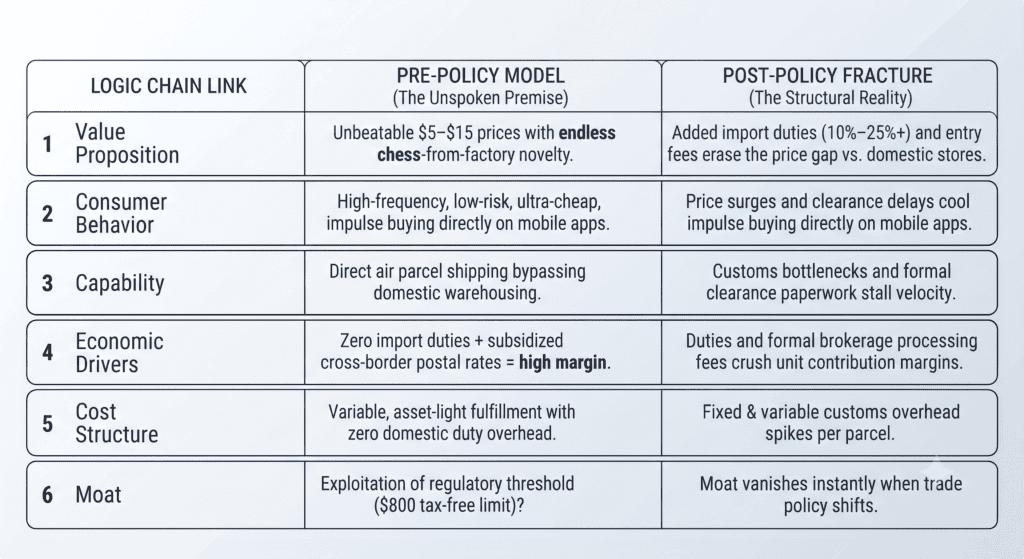
Notice where the primary fracture occurs: at the intersection of Cost Structure and Economics. By eliminating Section 321 de minimis, every individual parcel faces standard import tariffs and formal customs entry processing. Processing tens of millions of small $10 parcels individually under formal customs clearance increases fixed brokerage overhead beyond unit-level economic viability.
When the Cost Structure link snaps, it triggers a failure cascade backward down the chain. To absorb customs costs, prices must rise. Higher prices degrade the Value Proposition, altering Consumer Behavior, turning ultra-cheap impulse buys into deliberate shopping decisions where domestic retailers become competitive again.
A regulatory gap is an operational tactic, not a defensible moat. Any strategy built on regulatory arbitrage assumes regulators and domestic incumbents will remain passive forever. When a moat relies on policy gaps, the business is borrowing time, not building enterprise value.
2. The Fiduciary Trap: Why the Stress Test Was Predictable
For Board Chairs and Independent Directors, this crisis exposes a critical oversight lesson: governing the plan is not the same as governing the assumptions beneath the plan.
The closing of the de minimis loophole was an entirely predictable stress test for three reasons:
- Temporary Regulatory Arbitrage: When cross-border volume reaches critical mass, local tax authorities and domestic retail lobbies always intervene to protect their tax base and employment.
- Asymmetric Distortion: Domestic businesses paid bulk import tariffs and local warehousing taxes while cross-border dropshippers paid zero, creating unstoppable political pressure to level the playing field.
- Infrastructure Capacity Caps: Inundating logistics systems with over $1 billion low-value air packages annually creates physical bottlenecks and security risks at ports of entry.
In our governance framework, when leadership fails to surface these unspoken premises, the organizational trust flywheel stalls on Accountability. When broken logic is disguised behind aggressive marketing scale, it eventually manifests as operational friction and stakeholder trust erosion.
3. The Pivot Scenarios: Trade-Offs in Capital Allocation
Fairness requires acknowledging that platforms like Shein and Temu possess real operational strengths, specifically/ agile data algorithms, real-time demand forecasting, and ultra-responsive factory integration. However, software speed cannot override trade physics. To repair their logic chain, executives face distinct capital allocation trade-offs, such as:
- Scenario A: Pivot to Bulk Ocean Freight & Local Warehousing (3PL Model)
Consolidating SKUs into ocean container shipments to U.S.-based regional distribution centers lowers freight cost per unit, helping offset tariff duties and shortening final delivery to 1–3 days. The Trade-Off: This destroys their asset-light flexibility, tying up immense capital in inventory holding costs and domestic warehouse leases.
- Scenario B: Onshoring Marketplace Sellers
Recruiting domestic merchant partners who hold inventory inside U.S. borders shifts the initial import duty burden onto third-party sellers while preserving platform commission fees. The Trade-Off: Platform control over quality and pricing dilutes significantly. - Scenario C: Minimum Order Value (MOV) Bundling
Instituting $35–$50 minimum basket thresholds spreads fixed customs brokerage fees across multiple items. The Trade-Off: This directly suppresses lower-income trial buyers who relied on single $5 orders.
We are already seeing a global domino effect as the European Union advances plans to abolish its €150 duty-free threshold, forcing cross-border players to replicate these heavy localized models worldwide.
4. The Boardroom Audit: 5 Questions Before Committing Capital
The situation facing Shein and Temu offers an urgent reminder for CEOs, directors, and investors: Audit your strategy logic chain before the market enforces the lesson for you.
Before approving annual budgets or major capital deployments, ask your leadership team these five diagnostic questions:
Q1: Are the 6 logic links sequentially connected? Can every department head state how operational capabilities directly sustain the cost structure and drive target consumer behavior?
Q2: What unspoken premises sit at the base of our PILA reasoning stack? What implicit assumptions are we making about regulation, tariffs, or competitor passivity that could invalidate unit economics if changed?
Q3: Is our moat genuine or borrowed? Are we building proprietary capabilities and network effects, or are we riding a temporary market anomaly?
Q4: Have we stress-tested unit economics? If our primary cost advantage were reduced by 20% tomorrow, does the logic hold, or does the chain snap?
Q5: How does this impact our Trust Flywheel? If our logic fails, are we eroding stakeholder trust through missed targets, hidden price hikes, or operational friction?
Strategy is about deliberate and aligned choice, causal rigor, and structural load capacity. When you stress test your strategy logic chain early, you uncover blind spots, audit business models, challenge fragile assumptions, and de-risk capital before execution begins.
***
Josiah Go is the Chairman and Chief Innovation Strategist of Mansmith and Fielders Inc. He is the author of 20 bestselling strategy and marketing books, and co-creator (with Chiqui Escareal-Go) of the PILA Reasoning Stack, Strategy Logic Chain, and the Trust Economy Flywheel.