


While visiting Bangkok with some old friends, we stopped by a popular shopping mall where one of them decided to get a suit made.
The proposition stopped me in my tracks: One coat. One shirt. One pant. One tie. Custom-fitted. Ready in 24 hours for roughly US$137 (Baht 4,500, or Php 8,300).
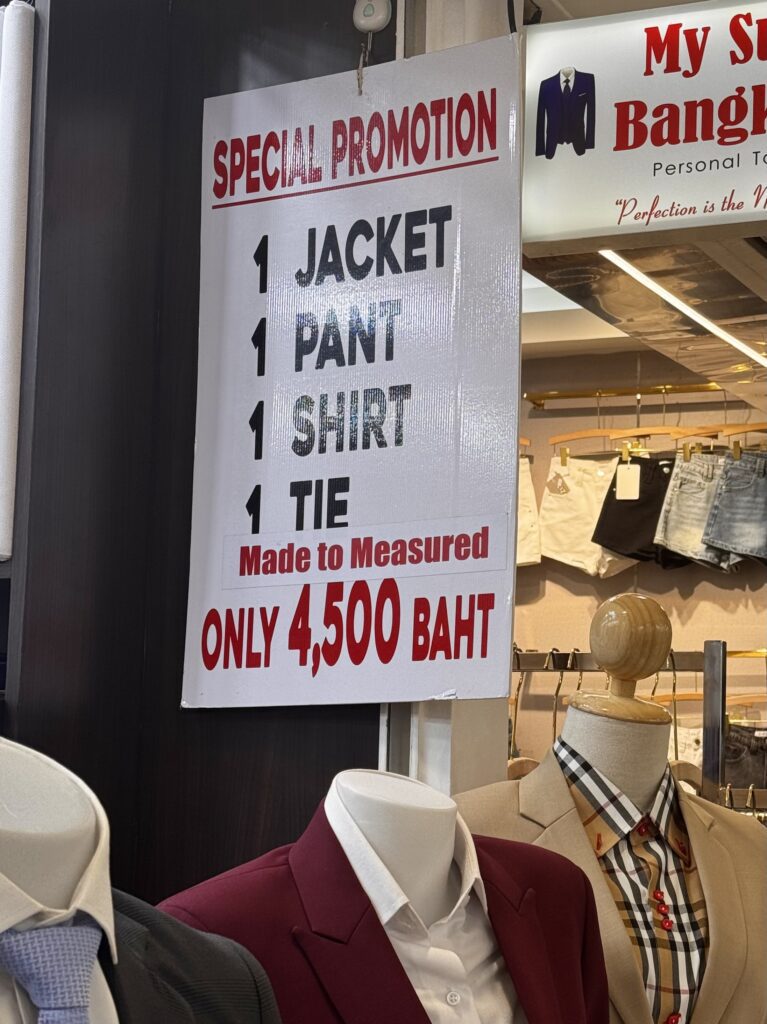
My friend ended up upgrading his raw material to higher-grade wool swatches and paid more than 3x the advertised package price for several more sets.
That single transaction made the strategy behind the proposition completely clear.
Because on the surface, it looks like a simple low-cost tailoring business competing on cheap labor. But it is actually solving a much harder business problem:
How do you deliver custom value without allowing customization to destroy speed and unit economics?
I decoded the proposition using our 6-Link Strategy Logic Chain:
Value Proposition → Consumer Behavior → Capability → Economic Drivers → Cost → Moat.
And the answer is far more compelling than “cheap labor.”
1. VALUE PROPOSITION: Made-to-Measure (MTM) Arbitrage
The offer combines three benefits that normally work against each other:
- Customization
- Speed, and
- Affordability.
Traditional bench bespoke gives you complete customization, but usually at a higher price and longer lead time requiring multiple basted fittings. Off-the-rack gives you speed and affordability, but sacrifices fit and personalization. The fast-tailoring proposition sits in the middle: Made-to-Measure (MTM) or controlled customization.
It isn’t trying to deliver maximum customization or maximum craftsmanship. It delivers:
- Enough customization to feel personal.
- Enough quality to look sharp.
- Fast enough to fit the customer’s itinerary.
- Affordable enough to feel like an exceptional deal.
Instead of drafting an individual paper pattern from scratch for every customer, the tailor modifies pre-graded master block patterns. They adjust dynamic parameters: sleeve length, jacket length, chest, and waist taper, while keeping complex structural anchors like armhole height and shoulder pitch standardized.
2. CONSUMER BEHAVIOR: Turning the Tourist Itinerary into the Buying Trigger
This may be the most clever part of the business model.
At home, getting a suit made can become an involved project:
Find a tailor → Make an appointment → Measure → Wait → Fitting → Alteration → Collection
But a tourist in Bangkok already has a fixed window of time. The tailor changes the customer’s question from “Do I need a suit right now?” to “I’m already here for four days. Why not get one made?”
Now the itinerary becomes part of the value proposition:
- Day 1: Choose fabric, measure, pay.
- Day 3: Deliver finished garments to your hotel, fit, and fly home.
The 24-to-48-hour promise is therefore more than an operational capability. It changes customer behavior.That is a critical strategic distinction.
3. CAPABILITY: Orchestrating a 3-Tier Shared Ecosystem
The storefront looks like a vertically integrated atelier, but the underlying system is actually a distributed, white-label manufacturing network operating across three distinct tiers:
Tier 1: Textile Distributors
Tier 2: Retail Storefront
Tier 3: White-Label Cut-Make-Trim (CMT) Factories
- Tier 1 (Textile Distributors): Wholesale fabric importers in districts like Phahurat supply retail shops with swatch books (bunch books), allowing retailers to offer hundreds of fabric options without tying up capital in raw cloth inventory.
- Tier 2 (Retail Fronts): The mall booth acts purely as a customer acquisition interface, sales engine, and measurement hub.
- Tier 3 (White-Label CMT Factories): Off-site workshops in areas like Pratunam cut, make/sew, and trim (CMT) garments for dozens of retail storefronts simultaneously.
The key capability is therefore not merely having competent tailors, but supply chain orchestration and measurement precision, the ability to repeatedly convert an unfamiliar customer’s measurements into an acceptable garment within a highly compressed production cycle.
4. ECONOMIC DRIVERS: Negative Working Capital & The Upsell Engine
How does a $137 package generate sufficient contribution across three separate ecosystem players? The answer lies in negative working capital, clear channel profit division, and aggressive customer acquisition mechanics.
The Financial Catalyst: 100% Upfront Cash Deposit
When the customer places an order, the retailer collects a 100% upfront payment. This single step eliminates cash flow lag entirely:
- The 100% payment immediately covers the combined cost of the wholesale fabric (30%) and the factory labor ticket (55%) before production begins.
- The business operates with zero inventory risk and negative working capital, the customer finances production up front.
- The remaining margin covers retail rent, referral commission fees (to drivers or concierges), and net profit.
The Real Monetization: COCA Arbitrage & Fabric Upselling
The headline $137 offer is effectively a Cost of Customer Acquisition (COCA) product. It gets the customer through the door at a price point that feels almost risk-free.
Once the customer is touching fabric swatches, the salesperson introduces higher margin upgrades.
When my friend upgraded his raw material and spent more than 3x the advertised package price, the store captured high-margin incremental profit. The baseline $137 offer covers operational overhead; the fabric upgrades generate the incremental net profit.
5. COST: Standardizing What the Customer Doesn’t Value
It is tempting to explain the model as simply having cheaper labor. Low labor cost helps, but the real enemy is complexity.
Every additional option creates operational consequences: more fabrics, more patterns, more special requests, more exceptions, more alterations, and more rework. Eventually, customization destroys speed. Then it destroys quality. Then quality destroys economics.
So the best fast-custom businesses don’t maximize customization. They architect it. They follow a broader strategic principle:
Standardize what the customer doesn’t value. Customize what the customer notices.
The customer notices fit, speed, personalized linings, and the luxury consultation ritual. They rarely notice whether the shoulder pads, internal canvas, or base pocket constructions originate from a standardized, pre-graded master block.
6. MOAT: From Local Transaction to Lifetime Re-Order Pipeline
A competitor can easily copy the $137 price point, the 24-to-48-hour promise, the storefront, and even use the exact same Pratunam factories. So if the moat is simply about being cheaper and faster, there is very little moat.
The real, defensible moat accumulates behind the scenes:
- Pattern & Fit Knowledge: Digitizing and storing the client’s finalized measurement profile after they depart.
- Zero-Acquisition-Cost Re-Orders: Converting a one-off $137 tourist visit into a direct-to-consumer digital client who re-orders suits and shirts via email or WhatsApp, shipped straight from Bangkok.
Physical Visit ($137) → Pattern Digitized → Lifetime Re-Orders
While the storefront is visible, the backend digital pipeline is not. That is where a durable competitive advantage emerges.
Where The Strategy Can Break
This is where the 6-Link Strategy Logic Chain becomes more than a framework for explaining success. It becomes a stress test.
- Value Proposition Breaks: If “custom” starts feeling like cheap alterations, the customer stops perceiving $137 as extraordinary value.
- Consumer Behavior Breaks: The customer has limited time. If they don’t trust the tailor to deliver before their flight, the entire proposition loses its behavioral power. Speed creates value only when the customer believes the promise of the tailor.
- Capability Breaks: Demand can outrun capacity. Misreading a stance measurement requires a full recut, causing factory queues to stall during peak tourist season.
- Economics Breaks: A single complete remake wipes out the contribution margin of 2 to 3 successful orders. A remake rate above 3–5% quickly turns an apparently busy shop unviable.
- Cost Breaks: Every exception adds complexity. Once too many orders become “special cases,” the production system loses repeatability. Complexity is the hidden tax on customization.
- Moat Breaks: If competitors copy the visible proposition faster than the original operator converts physical experience into digital re-order retention, the offer becomes commoditized.
The Strategic Lesson
What began as a simple shopping trip became a strategy lesson. The core issue I investigated is: How can a business give customers the feeling of customization without allowing customization to destroy speed and economics?
The answer is a coordinated operating system, not maximum craftsmanship. The right level of quality for the target customer, not simply a low price.
A value proposition whose perceived benefit is substantially greater than its cost. That is what the six links reveal:
Value Proposition gives the customer a reason to buy → Consumer Behavior gets the customer to act → Capability makes the promise deliverable → Economic Drivers make the business worthwhile → Cost makes the proposition affordable → Moat determines whether the advantage lasts.
And this is perhaps the most important takeaway: The $137 isn’t the strategy. The 24 hours isn’t the strategy. The strategy is making customization behave like mass production.
That is a lesson worth studying far beyond suits.
***
Josiah Go is the Chairman and Chief Innovation Strategist of Mansmith and Fielders Inc. He is the author of 20 bestselling strategy and marketing books, and co-creator (with Chiqui Escareal-Go) of the PILA Reasoning Stack, Strategy Logic Chain, and the Trust Economy Flywheel.