
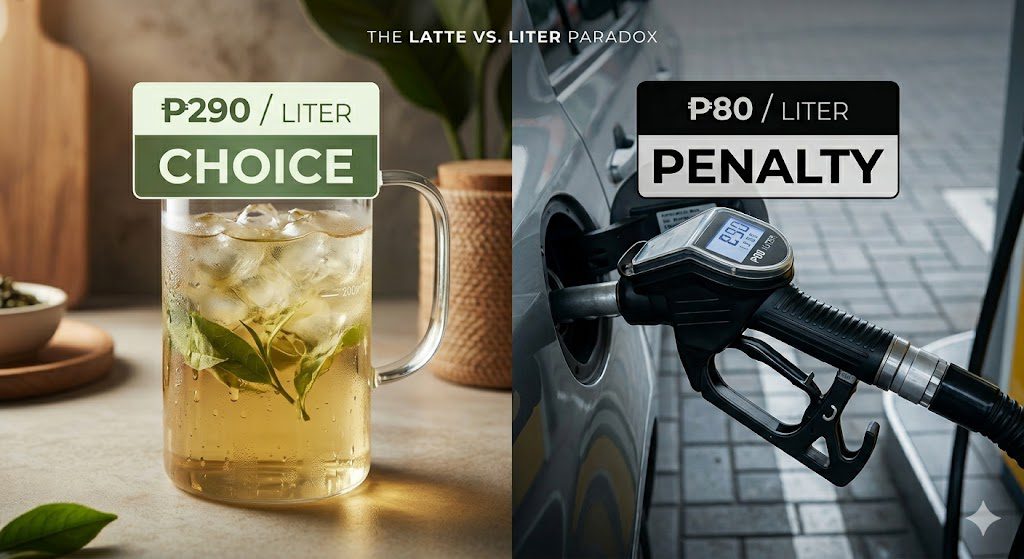
The other day, I bought a liter of my favorite Jasmine tea at Opus Mall. It cost me ₱290. I paid for it, enjoyed it, and didn’t feel even slightly offended by the price. It made me think about how I feel the same way at a café, where a venti latte costs over ₱200 for just half a liter. Yet, I reflected on why I feel a familiar surge of annoyance whenever fuel prices tick up.
I’ve reviewed over 4,000 strategy initiatives in my 35 years at Mansmith and Fielders, and this disconnect is one of the most fascinating “logic gaps” in the market. We will happily pay ₱290 for a liter of flavored water, a product with a massive profit margin, but we will revolt over ₱80 for a liter of a high-tech, low-margin, energy source that moves a two-ton vehicle.
Why? Because the tea is a choice, while fuel is a “penalty.” Consider these strategic shifts
1. Stop Being Transactional
The reason people don’t complain about coffee or tea is that they are in control. When you buy gas, you’re just paying for the right to get to work or go home. It’s not a treat; it’s a chore.
If you only talk about price and octanes, you are reinforcing the consumer “tax” mentality and inviting price-comparison behavior. You are essentially training your customers to be disloyal.
Fuel companies live and die by volume because their margins are razor-thin, often dictated by global oil prices. But when your product feels like a mandatory tax, customers resent you.
Except for those under a corporate “purchase order” scheme, they’ll drive a kilometer out of their way just to save ₱0.50 per liter, not because the money changes their life, but because they hate the feeling of being “held hostage” by your pump. You aren’t just selling fuel; you’re selling a “grudge.”
2. Stop “Big Payment” Pain
Stop making people pay for everything all at once.
When you force someone to swipe their card for a full tank, you’re hitting them with a “pain of payment” that lingers.
You’re making them feel the full weight of the expense in one go. If a tea shop forced you to buy 50 liters upfront, you’d hate them too.
If we can break this down—letting people “load” their fuel like they load their mobile phones or offering bite-sized digital payment options—we take the “sting” out of the transaction.
People don’t just hate the price per liter; they hate the shock of the total bill.
3. Stop Commodity Trap
Most gas stations are just empty concrete with a pump in the middle. You are sitting on the most valuable, high-traffic land in the country, and you’re treating it like a parking lot.
You don’t need a fancy high-end lounge; you need the basics done well. In the Philippines, the competitive advantage for a station isn’t your fuel grade; it’s your restroom. This is the “Sanitation Moat.” If a driver knows your station is the only one on the highway where the bathroom is clean and the soap is always stocked, they will stop at your station every single time. You’ve stopped being a low-margin commodity and started being a high-value relief.
4. Stop Repeating Rituals
I see many companies focus on the “rituals” of business—the fancy totems, the polished paint, and the big TV ads—while the actual experience for the driver is falling apart.
If your station looks shiny but the service is slow, you’re just putting lipstick on a pig. Customers know when you’re trying to trick them with surface-level glitz instead of giving them real value. Stop focusing on the “price totem” and start focusing on the “driver’s dignity.”
Customer Experience
If you want to stop being treated like a “villain,” stop acting like a utility.
You can’t control the world oil price. I know that. But you can control how a driver feels when they pull into your lot. Make it faster. Make it cleaner. Make it easier. Give the driver a reason to pick you that has nothing to do with the price per liter.
In the end, people will forget the price difference, but they will never forget the station that didn’t make their day harder.