
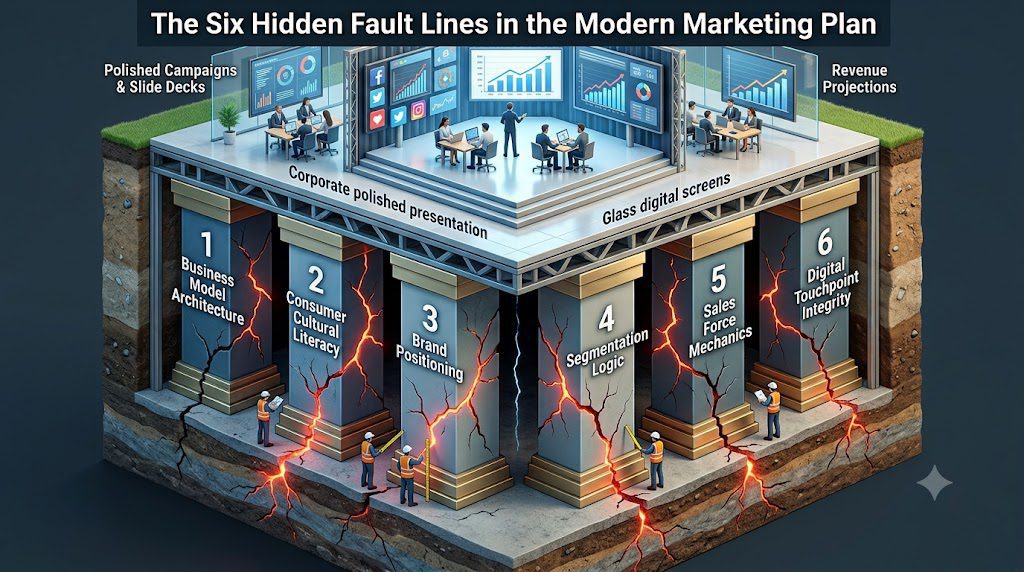
Most marketing plans look impressive on paper. They contain polished slide decks, ambitious revenue projections, detailed media strategies, and highly creative campaign concepts.
Yet in a volatile marketplace, plans often because leadership overlooked a hidden strategic fault line.
When an organization experiences declining revenue, weakening customer loyalty, inefficient sales operations, or erosion of brand trust, the visible problem is often only a symptom. The deeper issue is usually a misalignment somewhere within the business architecture.
To build a resilient growth strategy, leadership teams must look beyond surface-level metrics and conduct a disciplined audit of six critical dimensions.
Leaving even one of these areas unexamined creates an invisible weakness that can eventually compromise the entire marketing plan.
1. Business Model Architecture: The Risk of Obsolete Value
A resilient business model must continuously evolve to solve relevant customer problems because operational improvement cannot repair an outdated value proposition.
The common executive assumption is that when sales decline, the solution is simply to increase advertising investment, expand promotions, or engage a more aggressive digital agency.
However, many organizations spend significant resources optimizing campaigns for a value proposition that no longer matches changing customer needs, competitive realities, or market conditions.
You cannot optimize your way out of a broken business model.
A company can become highly efficient at delivering a product or service that the market no longer values. In this situation, additional marketing investment only accelerates the decline.
Leadership must establish a continuous validation process, treating the value proposition not as a permanent asset but as a business hypothesis that must be regularly tested against changing customer expectations.
If your organization cannot clearly articulate the customer problem it solves today, your marketing investment may simply be subsidizing yesterday’s business model.
2. Consumer Cultural Literacy: The Air-Conditioned Boardroom Trap
True market alignment requires more than data analysis. It requires cultural literacy, the ability to understand the deeper motivations, concerns, values, and behaviors that influence consumer decisions.
The common executive assumption is that dashboards, market reports, and aggregated research provide a complete understanding of the customer. They do not.
Data tells you what consumers are doing. Cultural understanding tells you why they are doing it.
When organizations rely exclusively on boardroom metrics without spending enough time talking to customers and observing real customer behavior, they risk becoming disconnected from the communities they serve.
This creates campaigns that may appear logical internally but feel irrelevant or insensitive externally.
Consumer trust is built through relevance.
A brand that understands the lived realities of its customers earns stronger relationships than a brand that only understands their statistics.
Leadership teams must combine quantitative analysis with direct market immersion, customer conversations, and frontline observation to ensure strategy reflects reality.
3. Brand Positioning: The Illusion of the Fluency Trap
Strong brand positioning must be built on meaningful differentiation, operational truth, and genuine customer value.
However, many organizations confuse visibility with competitive strength.
This creates what can be called the Fluency Trap.
A brand becomes familiar, recognizable, and highly visible, but lacks the deeper advantages that protect it when competition intensifies.
The common executive assumption is that strong awareness, viral campaigns, and high engagement automatically translate into market leadership.
But awareness does not equal loyalty.
Recognition does not equal switching costs.
When disruption occurs or competitors introduce lower-priced alternatives, brands built only on communication can quickly lose relevance. A sustainable position requires more than a compelling message. It requires a defensible advantage that competitors cannot easily copy.
A positioning audit must examine whether the brand is protected by real customer value or only by marketing visibility.
4. Segmentation Logic: The Flaw of Arbitrary Buckets
Effective segmentation requires understanding how different customers think, behave, and make decisions under changing conditions.
The common executive assumption is that broad demographic categories are enough to predict consumer behavior.
But customers within the same income group may have completely different priorities, fears, and definitions of value.
Economic pressure changes behavior.
Inflation, uncertainty, and changing lifestyles influence how consumers evaluate risk and spending decisions.
A customer may not simply become “more price sensitive.”
They may become more focused on trust, convenience, durability, or long-term value.
Traditional demographic segmentation often misses these deeper behavioral shifts.
Organizations must move toward more dynamic, behavior-based segmentation that considers customer motivations, decision patterns, and changing needs.
The goal is not merely to identify who customers are.
The goal is to understand why they choose.
5. Sales Force Mechanics: The Volume vs. Lifetime Value Conflict
A strong marketing strategy can fail if the sales system is misaligned with long-term business objectives.
The common executive assumption is that if the sales organization achieves monthly volume targets, the distribution system is healthy.
However, short-term sales incentives can sometimes create long-term damage.
When compensation systems reward transactions above customer value, sales teams may prioritize immediate volume at the expense of margins, customer relationships, channel health, and future growth.
The organization may appear successful while quietly weakening its foundation.
Leadership must audit whether sales incentives encourage the right behaviors. The goal is not simply more transactions, but healthier customers, stronger relationships, sustainable margins, and long-term value creation.
A successful sales force does not only generate revenue. It strengthens the business ecosystem.
6. Digital Touchpoint Integrity: Cognitive Fatigue and Hidden Friction
A successful digital strategy is built around simplicity, trust, and customer convenience.
The common executive assumption is that increasing digital traffic and adding more features will naturally produce higher conversion.
However, complex interfaces, unclear processes, and unnecessary friction can create customer fatigue and reduce purchase completion.
A digital platform should be a frictionless path toward value, not an obstacle course.
Every unnecessary step creates a potential point of abandonment.
Organizations must regularly audit their digital experiences to identify barriers that prevent customers from completing their journey.
The goal is not simply generating more traffic, but converting attention into meaningful customer relationships.
A strong digital experience reduces friction, improves trust, and increases lifetime customer value.
Alignment is Key
Strategy is not simply about choosing which actions to pursue. It is about ensuring that the entire business system is aligned before investing more resources into growth.
Many organizations respond to declining performance by increasing activity: More advertising. More promotions. More campaigns.
But more activity cannot compensate for strategic misalignment. Growth does not come from doing more marketing.
Growth comes from ensuring that the business model, customer understanding, positioning, sales execution, and customer experience are strong enough to deserve more marketing investment.
Before launching your next major campaign, audit the foundation beneath the campaign. The most expensive mistake in business is not spending too much on marketing. It is spending more money accelerating a strategy that is fundamentally broken.
The best marketing plans are not built only on creativity, but on clarity, on diagnosis. Most importantly, they are built on a business system designed to create sustainable value.
***
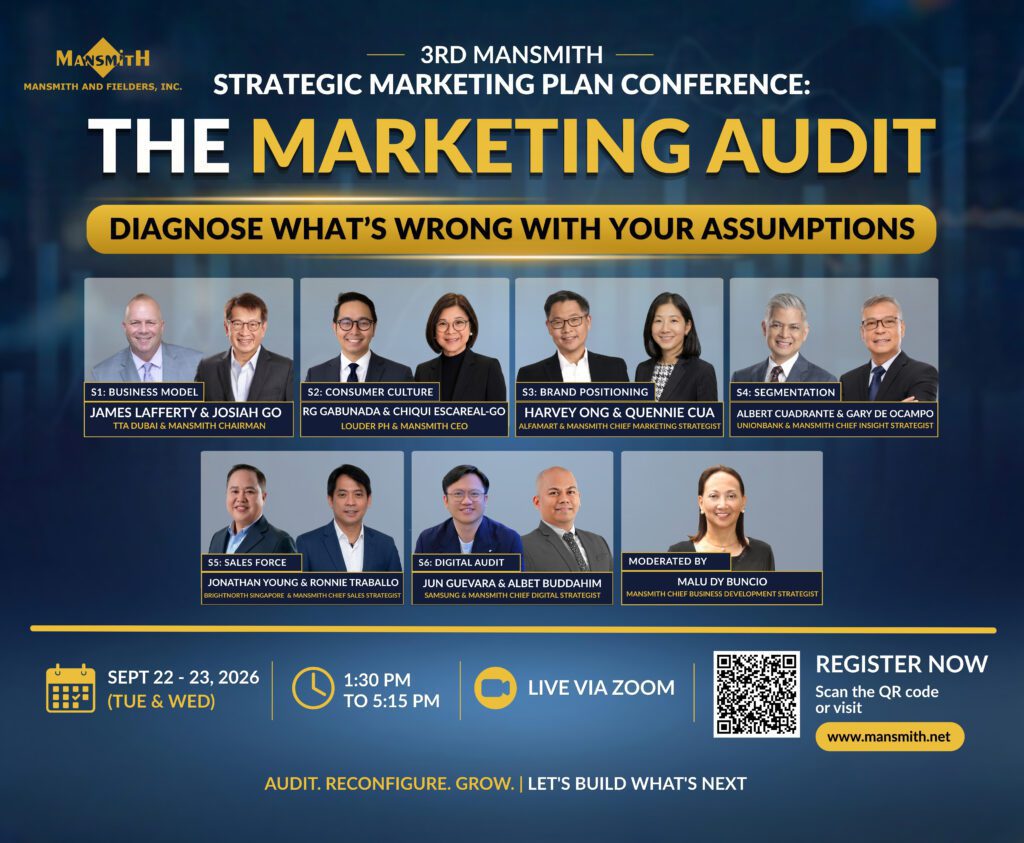
Josiah Go is the Chairman of Mansmith and Fielders, Inc. He will speak on Business Model Architecture Audit at The 3rd Strategic Marketing Plan Conference: The Marketing Audit, happening on September 22–23, 2026, from 1:30 PM to 5:15 PM via Zoom Live Nationwide. For details and registration, email info@mansmith.net.