

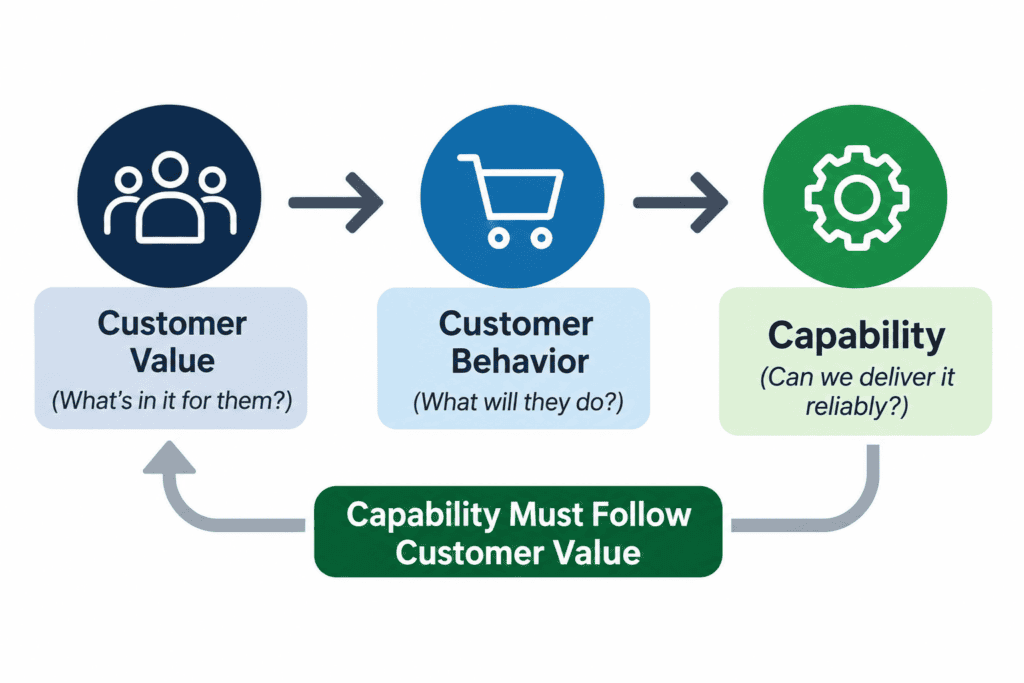
Note: This is Step 3 of the six-step Strategy Logic Chain.
A company can have an attractive value proposition, strong customer interest, and substantial resources yet still fail to deliver what it promises. The problem is often not a lack of demand or resources. It is the absence of the capabilities needed to turn the promise into a consistent customer experience.
Under the Strategy Logic Chain, Capability is Link 3. It follows Value Proposition (Link 1) and Consumer Behavior (Link 2). The value proposition defines the benefit customers are promised. Consumer behavior identifies what customers must do to realize that benefit. Together, they determine what the enterprise must be capable of doing.
Resources Are Not Capabilities
Resources are what a company has: people, capital, technology, facilities, data, inventory, and distribution networks. Capabilities are what it can reliably do by combining and coordinating those resources.
A retailer may own hundreds of stores, warehouses, and advanced inventory software. None guarantees that the right products reach the right stores at the right time. The retailer may have ample inventory but lack the forecasting, allocation, and replenishment capability to make it available where customers need it.
This explains why adding employees, equipment, or capital does not always solve a performance problem. The constraint may be the organization’s ability to coordinate what it already has.
Capabilities do not reside in individuals alone. They emerge when people, processes, technology, information, and decision-making work together to produce reliable results. Talented employees and sophisticated systems are resources; the organization’s ability to combine them to deliver customer value is a capability.
Different Promises Require Different Capabilities
The capabilities a company needs depend on its value proposition and the customer behavior required to realize it. Consider these examples:
- Direct selling. A company promising trusted product recommendations and an income opportunity must enable distributors to become productive while giving customers reasons to reorder. It needs effective onboarding, product education, sales support, order fulfillment, and distributor retention. Recruiting thousands of people adds network size, not necessarily sustainable sales.
- Telecommunications. A provider promising reliable connectivity and convenient digital self-service must deliver network performance while enabling subscribers to pay bills, upgrade plans, and resolve routine issues through an app. This requires network management, integrated customer data, reliable application architecture, automated billing, and cybersecurity. Investing in network infrastructure alone will not make digital self-service work.
- Banking. A bank promising convenient credit and rapid loan decisions must make applications straightforward while lending responsibly. It needs capabilities in identity verification, credit-risk assessment, fraud detection, regulatory compliance, and efficient processing. Technology and customer data are resources; using them to make fast, prudent decisions is the capability.
There is no universal capability checklist. A business competing on convenience needs different strengths from one competing on customization, affordability, reliability, or speed.
Building capabilities without first understanding what customers value can lead to investment in strengths that do not support the strategy.
Two Traps in Capability Planning
Organizations commonly fall into two opposing traps:
- The Rigid Verification Trap. Management demands conclusive proof of customer behavior before investing in the capabilities needed to test a new offer. In emerging markets, customers may not adopt until they experience the product. Requiring certainty upfront can paralyze innovation. Instead, identify critical assumptions, build the minimum capabilities needed to test them, and increase investment as evidence develops.
- The Heroic Operations Fallacy. Management launches a promise without checking operational readiness. Front-line employees compensate through manual workarounds, excessive overtime, and individual effort. The company may attract demand but cannot sustain the promised experience as volume grows.
The answer is neither to build everything before testing nor to launch on hope. Management must distinguish between capabilities needed to test an offer and those required to deliver it reliably at scale.
How Management Should Determine Capability
The Strategy Logic Chain gives leadership three questions:
- What value are we promising? Translate broad claims such as “better service” or “greater convenience” into a specific customer benefit.
- What consumer behavior must follow? Identify the action needed to realize that value: switching providers, reordering, paying a premium, recommending the product, or adopting a digital channel. In a new market, this behavior may still be a hypothesis to test.
- What must the company be capable of doing? Define the skills, processes, technology, coordination, and decision-making required to deliver the benefit consistently.
Management should then classify its readiness:
- Demonstrated: The organization already delivers the required outcome consistently.
- Existing but unscaled: The capability works in some circumstances but lacks the capacity or coordination to perform reliably at greater volume.
- To be developed: The necessary skills, processes, technology, or organizational arrangements are not yet in place.
This classification helps management decide what to strengthen, scale, or build, rather than treating every gap as a reason to buy technology or hire more people.
The Governance Mandate
Capability development is not solely an operations, technology, or HR responsibility. It is an enterprise-wide strategic decision.
The board should challenge whether proposed investments address real capability gaps and support the customer promise. The CEO must align the value proposition, intended behavior, and operating model. The COO must establish reliable processes and execution discipline. The CTO must ensure technology and data enable the required outcomes. The CHRO must develop the skills, leadership, incentives, and collaboration needed to sustain them.
Management should measure whether these investments improve customer outcomes and operating performance. Depending on the business, measures may include product availability, service reliability, fulfillment accuracy, processing time, customer retention, or cost to serve. The objective is not to count systems purchased or employees hired, but to establish whether the enterprise has become more capable.
The Strategic Sequence Matters
Capability is Link 3 because it follows from the first two links. A company must understand the value it intends to offer and the customer behavior needed to realize it before deciding what it must be able to do.
Starting with existing resources risks allowing yesterday’s strengths to dictate tomorrow’s strategy. Starting with customer value forces management to identify the capabilities that matter, the gaps that must be closed, and the investments that will make delivery possible.
A company should not build capabilities simply because it can. It should build them because its chosen customer promise requires them. That is the logic behind the Strategy Logic Chain.
***
Josiah Go is an entrepreneur, bestselling author, award-winning business educator, and independent director.