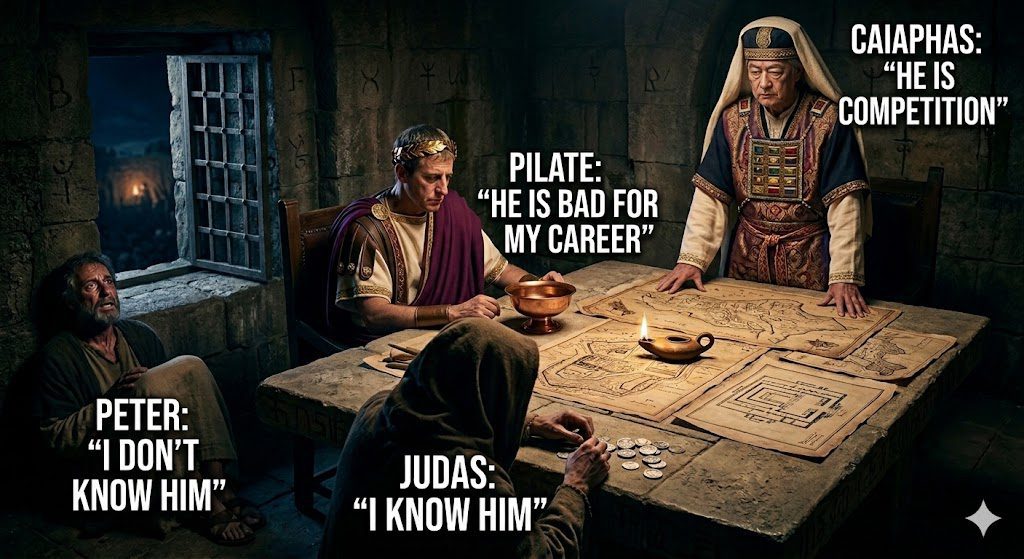

In our previous reflection, we decoded the Peter Trap: the moment a leader’s “internal load-bearing capacity” collapses under pressure. We saw that Peter’s failure was not a strategic betrayal or institutional preservation; it was a failure of assumptions (that he was unbreakable), the moment a brand promise liquidated in the face of fear. It was a failure of a Product-Market Fit, his internal “willpower-based” brand was not fit for the “volatility environment” of the cross.
But a trap is only a destination if you refuse to leave it. The true test of leadership is not the absence of failure, but the architecture of the return. If the night of the denial was a “volatility spike” that wiped out trust, then the morning on the shore was the beginning of a deliberate trust re-investment.
1. The Geometry of the Pivot (The Three-Fold Audit)
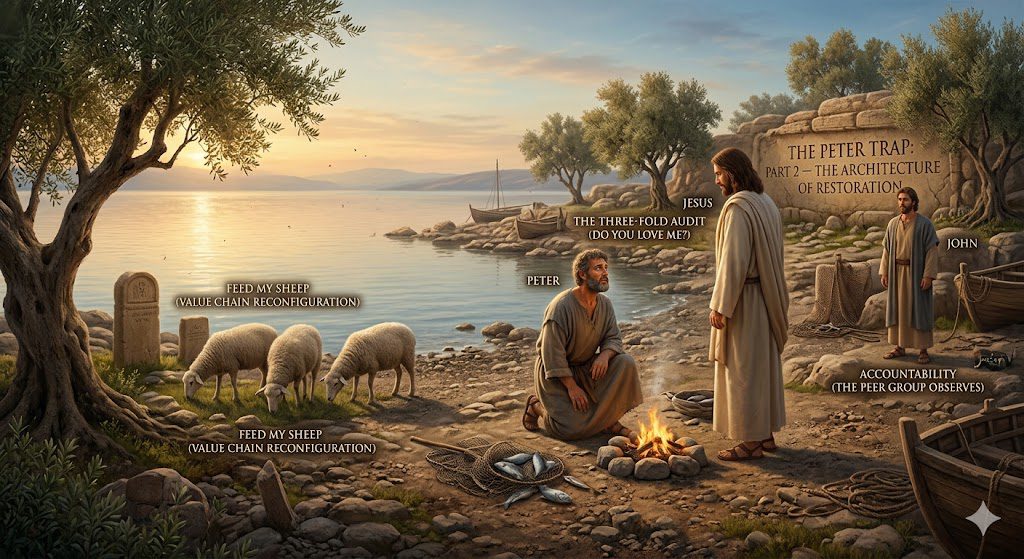
Peter’s restoration was not a general apology; it was a specific, deliberate re-verification of his “Right to Lead.” When the leader asked Peter, “Do you love me?” three times, it was a diagnostic check to match the three times Peter had denied the mission.
“He said to him the third time, ‘Simon, son of John, do you love me?’ Peter was grieved because he said to him the third time, ‘Do you love me?'” (John 21:17)
In the corporate world, we often try to “wash away” failure with vague messaging. But the Peter Trap teaches us that trust debt must be paid back in the same currency it was spent. If you failed the mission in the “courtyard” of public pressure, you must re-verify your commitment in a way that is just as visible and specific. Restoration is the process of closing the “information gap” created by your previous inconsistency.
2. Logic: Reconfiguring the Value Chain
Restoration is never about a leader “feeling better” about themselves; it is about re-focusing on the key processes of the organization.
Before the fall, Peter’s value chain was built on identity claims (“I will never deny“). This was fragile, relying on internal willpower. The instruction to “Feed my sheep” was a value chain reconfiguration: it forced a pivot from being a brand hero to becoming a value steward.
By focusing on the “sheep” (stakeholders) rather than his own ego, Peter lowered the search cost of trust. Stakeholders no longer had to wonder if Peter was reliable; they could witness his reliability through small, consistent, value-delivering actions. He moved from leading by command (which failed under pressure) to leading by enabling (which builds systemic resilience).
3. The Second-Order Effect: The Contagion of Grace
When a leader demonstrates a clear pathway from denial to restoration, they change the organizational DNA. They signal to the rest of the team that the culture is one of accountability, not erasure.
By seeing Peter submit to the “restoration audit,” the other apostles learned that the path to the future is paved not with perfection, but with the courage to repair what was broken. This creates a culture where truth-telling is more valuable than maintaining an image.
Turnaround Lessons for the Modern Leader
I. Own the “Coherence Leak”
When your actions fail to match your declared values, do not hide. A Peter-level failure is only fatal if you leave the denial standing. Transparency is the only tool that can reconnect a fractured leadership brand.
II. Restoration Requires “Micro-Consistency”
You cannot fix a massive breach of trust with one grand speech. You fix it through the “feed my sheep” method: small, daily, consistent actions that prove you are once again aligned with the core purpose. You must re-architect your daily value chain so that your reliability is a function of your system, not your mood.
III. The Audit of the Peer Group
Your stakeholders are your “auditors.” You must be willing to let them see the grueling work of re-verification publicly. If you are too proud to be audited, you are not ready to be restored.
The Diagnostic
If Part 1 of the Peter Trap asks, “Why did I collapse under pressure?” Part 2 asks the harder question: “Am I willing to do the work to re-pay the trust I liquidated?”
A leader is not defined by the night they denied the truth, but by the morning they returned to repair it. Restoration is the only way to turn a strategic failure into a permanent transition toward a higher level of integrity.
The Final “Killing Question” for the Series:
The Judas piece acts as a preventative security protocol, this Peter piece is your disaster recovery plan. Together, they form a complete “Leadership Operating System.”
- Judas Trap: How to spot the threat before it triggers.
- Peter Trap: How to recover when the system inevitably crashes.
“When you fail, and you eventually will, the system is already waiting for your next move. Will you choose the terminal silence of Judas, or the courageous, public audit of Peter? The architecture of your comeback begins with the answer to that question?”