

On August 27, 2026, I will celebrate 12 years of blogging.
When I started JosiahGo.com in 2014, my objective was simple: to share what I was learning and make practical business knowledge more accessible to students, entrepreneurs, managers and business owners in the Philippines.
I did not realize then that blogging would also become a record of my own reinvention.
I have my children to thank
I have to give credit to my children for my blogging journey.
My daughter, Tricia Gosingtian, an OG influencer and pioneer blogger, inspired me to start blogging. She opened my eyes to the possibilities of blogging and the power of having your own platform.
At the time, I was already deeply involved in business, marketing and entrepreneurship. But it was Tricia who made me see that I could use blogging to share what I knew with a much wider audience.
My eldest son, Chase Gosingtian, played another important role. He encouraged me to broaden my reach beyond the established business and marketing circles I had been interacting with. He pointed out that there were many younger people who did not have direct access to the CEOs, entrepreneurs, executives and other leaders in my network.
That resonated with me.
It became part of my mission: to make knowledge and insights from people I had access to available to a much wider Filipino business community.
Today, Chase has built his own career as Head of Technology for an Australian company.
Looking back, I find it quite meaningful that my children influenced this journey in different ways.
Tricia gave me the spark to blog. Chase helped me see the broader purpose of blogging. I am grateful to both of them.
Eight reinventions
Over the past 12 years, I can identify eight major areas where I progressively expanded my knowledge:
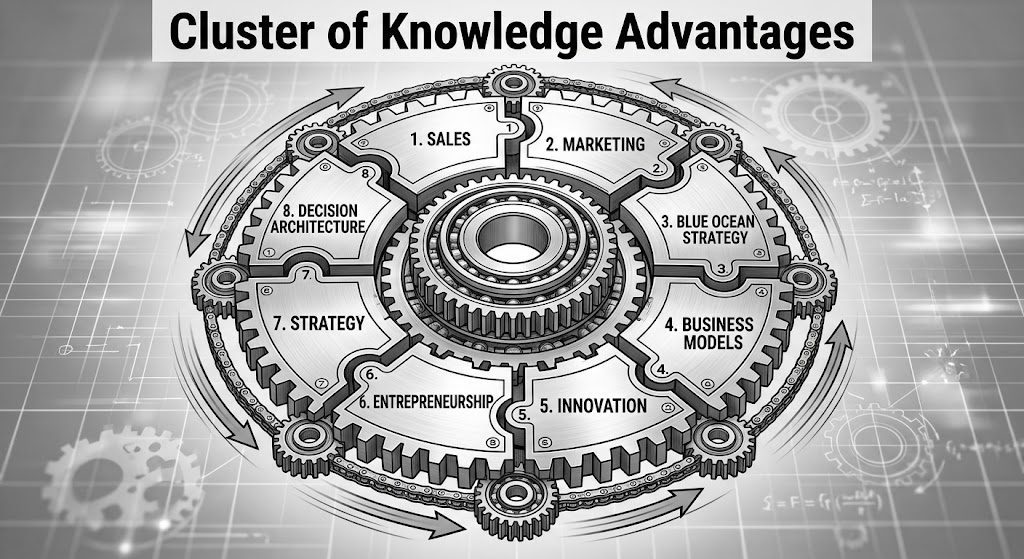
Sales → Marketing → Blue Ocean Strategy → Business Models → Innovation → Entrepreneurship → Strategy → Decision Architecture
When I compare where I started with where I am today, the distance seems enormous.
Yet these were not eight unrelated changes. Each became an adjacency to what came before.
I started teaching in Sales. I also had a direct sales company, Waters Philippines, which became the No. 1 distributor of Waters in Southeast Asia.
Sales gave me a foundation in business that I still value today. I learned how customers make decisions, how value is perceived, why people say no, how trust is built, and how execution determines whether an idea actually works.
From Sales, I moved into Marketing, which expanded my perspective from individual customers to markets, brands, positioning and consumer behavior.
Then came Blue Ocean Strategy, which changed how I thought about competition and creating new demand.
This led to Business Models, because creating value is only part of the equation. A business also needs to know how to deliver and capture that value.
Then came Innovation, which made me question existing assumptions and look for new possibilities.
Entrepreneurship expanded my understanding of opportunity, risk and execution.
Then came Strategy, which brought many of these ideas together around choices, trade-offs and competitive advantage.
Today, I am increasingly focused on Decision Architecture, how decisions are made, what assumptions influence them, what creates friction, and how organizations can create better conditions for better decisions.
From Sales to Decision Architecture
When I compare Sales with Decision Architecture, they seem like completely different worlds.
And they are.
But I did not leave Sales behind. The lessons are still there.
The progression has changed the way I look at business problems. A sales problem may actually be a marketing problem. A marketing problem may actually be an execution problem. An innovation problem may actually be a business-model problem. A strategy problem may actually be an assumption problem. And sometimes, what looks like an execution problem is actually a decision problem.
Eight lenses
This is probably the biggest realization I have had from the journey. I don’t see these as eight separate areas of expertise. I see them as eight interconnected lenses. Together, they have become my cluster of knowledge advantages.
My advantage is not knowing everything about each discipline. It is being able to look at a problem from different perspectives and connect theory with practice.
Theory gives me frameworks. Practice gives me reality. Experience gives me context. Connecting them gives me insight.
For example, a company may come to me thinking it has a marketing problem. But when you look through different lenses, the real issue may be the business model, the value proposition, the strategy, innovation, or even the way decisions are being made.
That is why I increasingly believe that some of the best insights happen between disciplines.
Blogging changed me too
Blogging was not only a way for me to share knowledge. It became a way for me to develop my own thinking.
Writing forces you to organize your thoughts. Research forces you to challenge assumptions. Interviews expose you to different perspectives.
Explaining an idea forces you to understand it better. And publishing consistently creates a record of how your thinking changes.
Over 12 years, I have written about marketing, strategy, innovation, entrepreneurship, business models, execution and many other business issues.
I have also been fortunate to interview leaders from different industries who generously shared their experiences so others could learn from them.
When I look at what I wrote 12 years ago compared with what I write today, the questions have changed.
That, to me, is a good thing.
The highs and the lows
There is another side to 12 years of putting ideas in public.
I have been imitated. I have been flattered. I have been criticized and blasted. I have experienced betrayal. But I have also been fortunate to know that some of my ideas have inspired others.
I have seen some of my ideas and frameworks repeated or adopted by others. I take that as a compliment.
It also shaped a principle I have carried throughout my career:
If you teach sales or marketing, you should have a solid track record of results, not just theories.
I have always believed there is a big difference between talking about business and actually doing it. Theory is important. Frameworks are useful. But I always ask: Has it worked for the person teaching it?
Theory matters. Frameworks matter. But before I put my time, money and people into training, I want to know whether the person teaching it has actually applied it and produced results.
Every experience taught me something.
When someone imitates you, it reminds you that ideas have value. When someone criticizes you, it forces you to examine whether your thinking is sound.
When people you trusted for a long time betray you, it hurts, but it also brings clarity. It reveals who they truly were all along. You learn that while trust should be given generously, discernment must never be abandoned.
When someone disagrees with you, it challenges your assumptions. And when someone tells you that something you wrote helped them, it reminds you why you write in the first place.
The difficult experiences made me stronger and more discerning. Most importantly, they made me more focused on excellence.
Once you put ideas into the marketplace, you cannot control how people will react.
You can control the quality of your thinking, the integrity of your work, and your willingness to keep learning.
Thank you, Inquirer
I also want to thank Inquirer for its trust and for cross-posting my articles.
Since 2014, my blog has been cross-posted in Inquirer Business every Friday.
That allowed ideas that started on my personal blog to reach a much wider audience and helped make practical business thinking accessible to more people.
Thank you for trusting my work and giving it a platform.
That trust means a lot to me.
What 12 years taught me
If there is one thing I have learned, it is that reinvention does not mean starting over.
It means building on what you know and moving into an adjacent field where you develop another perspective.
Sales did not disappear when I moved into Marketing. Marketing did not disappear when I moved into Blue Ocean Strategy. Each became another layer of understanding. Over time, those layers became connected.
So today, I don’t look at my career as a straight line. I see it as a growing network of knowledge and experience.
Eight reinventions. Eight lenses.
Perhaps the biggest benefit of continuous learning is not that we know more. It is that we see more connections.
That is what these 12 years have given me. More knowledge, but also more questions. More confidence in some ideas, and more humility about others.
I am grateful for the journey.
Grateful to the people who challenged me, to those who believed in me, even to those who criticized me or disappointed me.
And grateful to every reader who has told me that something I wrote made a difference.
Most of all, I am grateful that after 12 years, I am still curious. Still learning.
Still questioning. Still trying to be better.
Because perhaps reinvention is not about throwing away who you were.
It is about building on it.
And after 12 years, I am still building.
Thank you for being part of the journey.
On to the next chapter.