


Standing on the grounds of Shenzhen’s Talent Park, watching low-altitude airspace in action, you quickly realize that the future of logistics is in high-frequency aerial fulfillment. It is already happening in China’s tech capital. Yet, to understand the true commercial viability behind the spectacle, one must look beyond the initial visual novelty.
To unpack what was really happening beneath the surface, Chiqui and I hired a local guide on our second day in Shenzhen. We didn’t just want to watch drones fly overhead; we wanted to audit the operational reality, the underlying unit economics, and the physical infrastructure powering the entire system. Over the course of the day, we examined both receiving hubs (such as Shenzhen Talent Park) and active dispatching hubs (along Houhai and Shenzhen Bay Street), tracking the process from order placement to final pickup.
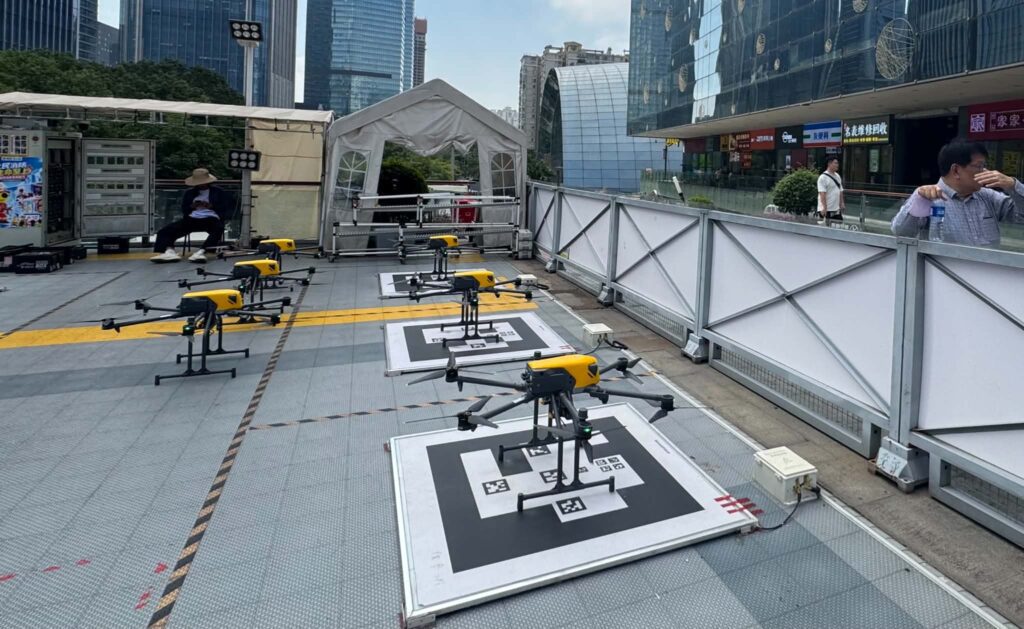
Our firsthand experience revealed a sobering operational reality: what is marketed as an instantaneous 15-minute drop often hit a 30-minute friction wall once we factored in ordering queues, payload loading, battery swaps, and the physical trek to the designated pickup kiosk. Standing around waiting that long as tourists highlighted a critical adoption bottleneck. However, viewing these friction points through an innovation lens reveals an important truth: these are not fatal structural flaws, but classic engineering and execution hurdles that operators will inevitably solve before mass scaling.
Drone delivery represents a fundamental restructuring of last-mile decision architecture, but its success depends on resolving these exact operational realities. Many legacy firms treat logistics as a game of incremental optimization, trying to make delivery vans slightly faster or motorcycle couriers more efficient. But as we apply the PILA Reasoning Stack (Problem, Insight, Logic, Assumptions), if your underlying strategic logic is flawed, scaling up merely multiplies your friction.
To evaluate where last-mile fulfillment is truly heading, we must analyze how delivery models have evolved, stress-test autonomous drones using the Strategy Logic Chain, and map the multi-order consequences reshaping commercial real estate, urban safety, and municipal policy.
1. The Evolutionary Context: Why 2D Road Delivery Hit a Wall
To understand why autonomous drones are taking off in China’s tech capital, we have to look at the structural limits of traditional delivery models:
- The Motorized Era: Delivery relied on vans and trucks. While this increased parcel volume, it hit a physical wall: urban road congestion. Adding more delivery vehicles simply added more traffic, increasing the cost-to-serve.
- The Gig-Economy Era: Smartphone dispatch platforms mobilized thousands of motorcycle couriers. This improved dispatch flexibility, but it kept variable labor costs high and created severe urban friction, as couriers routinely weave through traffic and dangerously mount pedestrian sidewalks to meet tight delivery deadlines.
- The Skyway Era: Drones move fulfillment from a 2D street grid to 3D low-altitude airspace. Delivery times are decoupled from road traffic, red lights, and surface bottlenecks, while simultaneously clearing pedestrian walkways of reckless delivery bikes.
Strategy Logic Chain Analysis: Drone Logistics
Applying the 6-step framework exposes why this business model passes the strategic stress test in high-density urban corridors, and where its operational failure points lie:
Value Proposition ➔ Consumer Behavior ➔ Capability ➔ Economic Drivers ➔ Cost ➔ Moat
- Value Proposition: A value proposition is a functional contract. Here, it is not the novelty of a flying machine, it is predictable, guaranteed fast fulfillment.
- Consumer Behavior: Consumer adoption relies on a strict trade-off: convenience vs. physical friction. During our field audit, our personal experience, and interviewing customers, revealed a hard behavioral rule: if delivery time stretches past 30 minutes, consumers revert to doorstep human couriers. The extra effort required to walk to a central pickup hub or park locker dissolves the entire drone value proposition once total fulfillment time exceeds half an hour. Yet, as operators refine their dispatch algorithms and expand landing kiosk density, this friction will shrink.
- Capability & All-Weather Execution: Capability is documented repeatability at load. Beyond airspace navigation software, this requires specialized operational hardware: standardized waterproof packaging and sealed drop boxes to protect meals and electronics from sudden downpours during open-air transit, alongside high-frequency battery maintenance. At the dispatching hubs near Shenzhen Bay, workers swapped and recharged batteries after almost every single flight, as battery life hovered around 20 minutes under payload weight. While high battery swap overhead and weather protection currently constrain turnaround speeds, these are classic engineering hurdles that next-generation battery chemistry, sealed containers, and automated swapping gantries will solve before scaling.
- Economic Drivers: Unit economics are driven by order drop density within a tight 3-kilometer radius and supervisory leverage, transitioning from one driver per vehicle to a single remote operator monitoring 6 or more automated flights.
- Cost Structure: The model trades variable operational expenses (courier payouts, fuel, motorcycle maintenance, traffic delays) for an upfront platform capital expenditure (drones, battery swap bays, waterproof packaging modules, and landing hubs) that offers a low marginal cost per drop only when turnaround speed remains ultra-fast.
- Strategic Moat: The true moat is not the airframe, it is securing low-altitude municipal airspace permits and locking up exclusive landing real estate atop commercial centers and residential hubs.
3. Multi-Order Thinking: Second and Third-Order Impacts
Evaluating drone delivery requires looking beyond the immediate flight (1st order) to understand how it reshapes commercial real estate (2nd order) and municipal governance (3rd order).
- First-Order Effect (Immediate Operational Impact): Fast, predictable fulfillment for light, high-priority goods under 5 lbs (prepared food, medicine, urgent dispatches). Direct labor substitution along dense routes.
- Second-Order Effect (Systemic Market Realignment): Retail storefronts on high-rent main streets lose their location monopoly. Fulfillment shifts to low-cost “dark kitchens” and micro-fulfillment hubs situated on cheaper rooftops, basements, or urban edges. Supply chains decentralize to hold inventory closer to the consumer.
- Third-Order Effect (Macro Societal & Governance Shifts): Shifting light parcels to the air significantly reduces motorcycle and e-bike congestion on city streets and pedestrian sidewalks, dramatically lowering sidewalk pedestrian hazards and traffic accidents. Cities transition from managing 2D street grids to monetizing 3D air corridors, turning low-altitude airspace zoning rights into municipal revenue assets.
4. Strategic Direction for Incumbent Fleets
Incumbent logistics operators running human-driven motorcycle fleets cannot defend a variable, labor-heavy business model against an autonomous platform operating with near-zero marginal labor costs. However, drone operators face their own operational walls, such as battery swap bottlenecks, waterproof container loading friction, and the 30-minute friction threshold we experienced firsthand.
The strategic direction for executives is clear: do not dismiss an innovation because of initial operational bottlenecks; recognize that early friction points are simply engineering targets waiting to be solved. Legacy couriers must pivot away from managing workforce rosters toward becoming capital-efficient fleet orchestrators, hub landlords, and local depot managers, anticipating a future where these bottlenecks are engineered away and autonomous delivery operates at seamless scale.
***
Josiah Go is the Chairman and Chief Innovation Strategist of Mansmith and Fielders, Inc., an independent director, and a bestselling author.