

On Good Friday, the spotlight naturally falls on Jesus Christ. But for those in leadership, the more uncomfortable case study is Pontius Pilate.
Pilate was not incompetent. He was not uninformed. In fact, he correctly assessed that Jesus posed no real political threat. His failure was more subtle, and far more common in today’s workplaces.
It was the isolation of ego.
In modern terms, Pilate was a regional managing director with a single KPI from headquarters: maintain stability. Governing Judea during Passover under Tiberius meant managing a volatile environment where one misstep could trigger unrest, and end a career.
Then came the pressure point. “If you let this man go, you are no friend of Caesar” (John 19:12, Gospel of John).
With one statement, the issue shifted from justice to survival.
The Logic of Expediency vs. The Logic of Truth
Pilate’s decision can be reduced to a brutal cost-benefit analysis:
- The cost of justice: potential riots, reputational damage, even accusations of disloyalty to Rome.
- The cost of execution: one innocent life.
He chose expediency.
Not because he was evil, but because he was protecting his position.
This is the Pilate Trap: when leaders convince themselves that preserving the system justifies compromising the truth.
The First Failure: Humility
Leadership breakdown rarely starts with bad data. It starts with a flawed inner core.
If Pilate had the humility to admit he was being cornered, he might have paused, consulted, or explored a third path. Instead, he projected control while quietly losing it.
Ego doesn’t like to look weak. So it isolates. And when ego becomes the loudest voice in the room, truth becomes negotiable.
The Pattern Still Exists
We see modern versions of Pilate everywhere:
- Executives who sign off on questionable decisions to “avoid rocking the boat.”
- Managers who stay silent because “it’s above my pay grade.”
- Leaders who privately disagree but publicly comply to protect their careers.
The titles have changed. The trap has not.
The Illusion of Neutrality
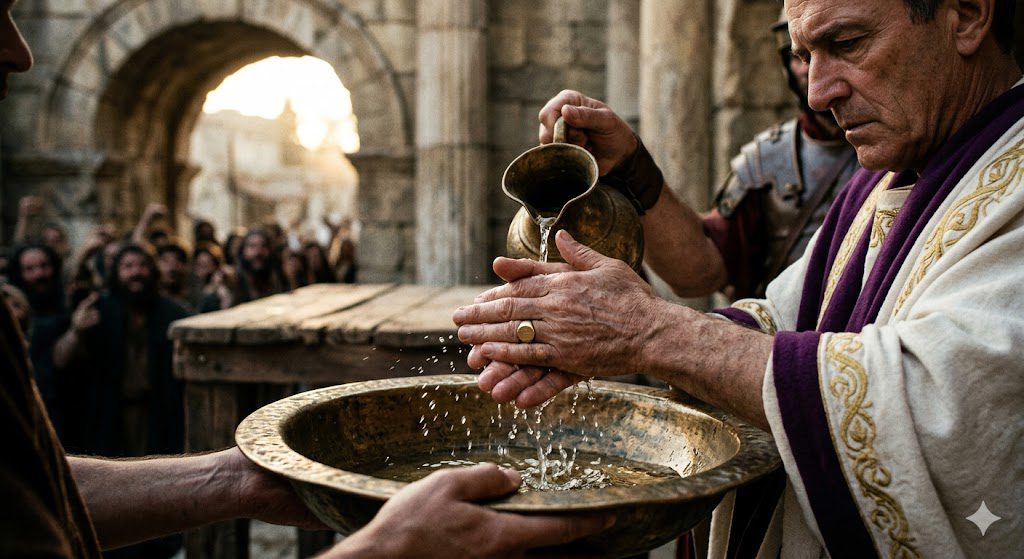
Pilate attempted a symbolic escape: washing his hands to signal he was not responsible.
But leadership does not allow neutrality.
To step back in a moment of injustice is not to be neutral. It is to enable the outcome.
Inaction is still a decision. And in high-pressure environments, silence often carries more consequences than speech.
From Expediency to Legacy
Pilate likely believed he was making a temporary decision to preserve order.
History decided otherwise.
He is remembered not for the crises he managed, but for the truth he abandoned. He became, in effect, the godfather of moral cowardice, an enduring symbol of what happens when leaders choose self-preservation over accountability.
This is the paradox leaders must confront: Job security is temporary.
Reputation is fragile. But integrity compounds over time.
Pressure Reveals the Real Leader
Crisis does not build character. It exposes it.
When the temperature rises, leaders do not suddenly become different people, they reveal who they already are.
Pilate’s external authority masked an internal gap. When pressure came, there was no foundation strong enough to hold the line.
That is why leadership is not just about strategy. It is about formation. Because when the moment of decision arrives, you will not rise to the occasion, you will default to your core.
The Accountability Gap
The most dangerous phrase in any organization is this: “It’s not my responsibility.”
It sounds harmless. It protects boundaries. It reduces risk.
But over time, it creates a culture where no one owns the outcome.
Pilate’s handwashing was not just personal failure, it was a leadership signal. It showed everyone watching that accountability could be avoided.
And cultures are shaped not by policies, but by what leaders tolerate.
Action Step: Put Down the Bowl
Most leaders will not face a decision as dramatic as Pilate’s. But the pattern appears in smaller, quieter ways every day.
This week, identify one situation where you feel the pull of expediency:
- A decision you are avoiding
- A truth you are softening
- A responsibility you are deflecting
Then do three things:
- Check your motive: Are you protecting the truth, or your position?
- Reject distance: Stop looking for ways to detach from the outcome.
- Own the decision: Take one concrete step toward what is right, even if it carries cost.
Because while the bowl may protect your role in the short term, only accountability protects your legacy.
On Good Friday, the story is not just about sacrifice. It is also about decision.
And for leaders, the question is unavoidable: When pressure comes, will you choose expediency or truth?