

Strategy does not fail in execution first.
It fails in logic.
What usually happens is this: teams build something that looks coherent on paper, defensible in meetings, and impressive in presentations, only to discover later that coherence is not the same as structural validity.
At that point, execution is no longer strategy. It is recovery. And recovery is always more expensive than discipline.
PILA: Where Logic Actually Lives
Within the PILA framework (Problem, Insight, Logic, Assumptions), many organizations over-invest in Problem and Insight. They become exceptionally good at identifying what is broken and why it is broken. But they rarely test the systemic question: Does the solution actually hold together under pressure?
That is the role of Logic.
Logic is not explanation; logic is stress testing. Because PILA sits inside the Trust Economy Flywheel, where transparency drives trust, weak logic cannot stay hidden internally. It quickly manifests externally through missed targets, operational friction, and trust erosion. You cannot hide structural weakness behind creative communication or aggressive sales push.
The Velocity Paradox
A common objection from growth-obsessed CEOs and CMOs is that deep structural validation slows down market momentum. This is a dangerous misunderstanding of speed.
Logic does not stall speed; it prevents you from running fast in the wrong direction.
The Logic Chain is a rapid, iterative sprint, not a bureaucratic waterfall. It allows leadership to fail on paper in minutes rather than failing in the market over quarters.
Scale does not fix bad logic. It multiplies it. If an idea does not pass all six steps in sequence, it does not deserve capital allocation. It deserves immediate review.
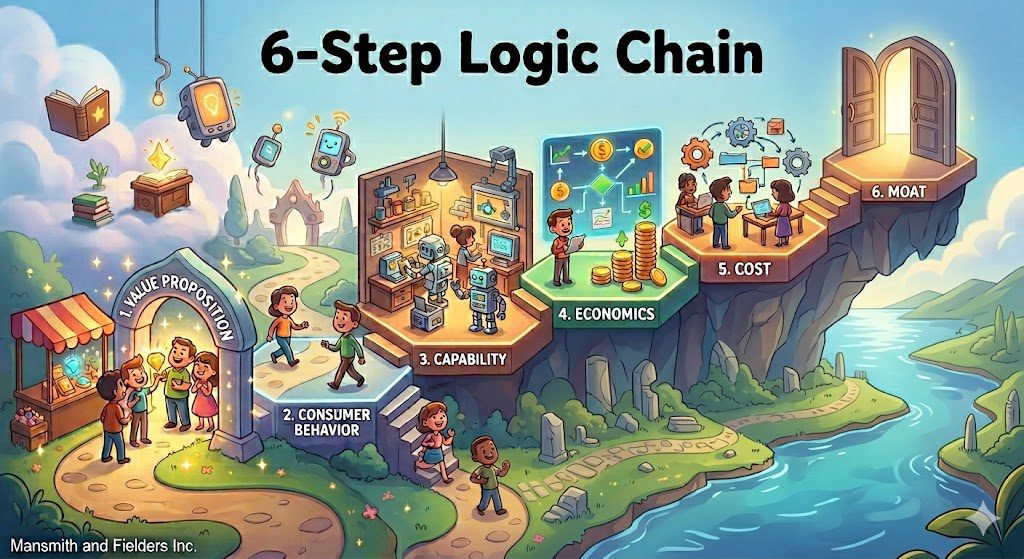
The 6-Step Logic Chain
Value Proposition ➔ Behavior ➔ Capability ➔ Economics ➔ Cost ➔ Moat
1. Value Proposition (The Commercial Contract)
Does this create a reason compelling enough for the market to choose it over the status quo? A value proposition is not branding; it is a financial and functional contract.
If the market cannot clearly see the distinct utility of your offer, the only remaining decision factor is price. Once price becomes your only differentiator, strategy has already surrendered to commoditization. For marketing executives, this step requires a measurable relative advantage score over existing alternatives, proving that the perceived benefit heavily outweighs the cost of entry.
2. Consumer Behavior (The Adoption Reality)
Will customers actually change what they currently do? This is where brilliant concepts quietly die. Markets do not change behavior simply because a new solution is marginally “better.” They shift when friction is actively removed or when the pain of the status quo becomes entirely unavoidable.
Every strategy must explicitly define the exact nature of the behavioral shift required:
- Trial: Breaking initial inertia.
- Switching: Overcoming competitor stickiness and loyalty loops.
- Habit Replacement: Rewiring daily routines permanently.
If you cannot define the specific friction you are removing, you do not have market demand. You have a customer preference. And passive preference never sustains top-line revenue.
3. Capability (The Operational Reality)
Can the organization build, deliver, and operate this solution consistently at load? Capability is not aspiration; it is documented repeatability.
Many strategies are conceptually flawless but operationally blind. To pass this gate, operations must demonstrate a predictable process repeatability index, meaning the system can deliver the value proposition without relying on heroic, unscalable, individual efforts that inevitably breakdown during expansion.
4. Economics (The Profit Reality)
Does this model generate real, structural profit before scaling? Revenue is a vanity metric; economics is structure. True business architecture requires clarity on:
- Margin Logic: A robust, positive unit contribution margin.
- Cost Behavior: Fixed versus variable cost dynamics under volume.
- Value Capture: The ability to retain earnings rather than passing all value to distributors or suppliers.
If profitability only appears at hypothetical scale without a clear structural advantage early on, scale is not a strategy. It is a capital-burning delay mechanism.
5. Cost (The Scalability Reality)
Does efficiency hold as we scale, or does it rapidly degrade? Cost is not a static line item on a spreadsheet; it is a dynamic behavior under growth conditions.
As a business grows, complexity grows exponentially. If your expansion destroys your underlying unit economics because of coordination overhead or supply chain bottlenecks, then growth is not success. It is fatal organizational exposure.
6. Moat (The Defensibility Reality)
Why does this business survive once it becomes highly profitable? Markets are ruthlessly efficient; competitors will instantly copy what works.
A true strategic moat exists only when your competitive advantage is structural—such as proprietary data loops, high switching costs, or unique ecosystem lock-in—rather than merely cosmetic, like temporary advertising dominance or a brief head start.
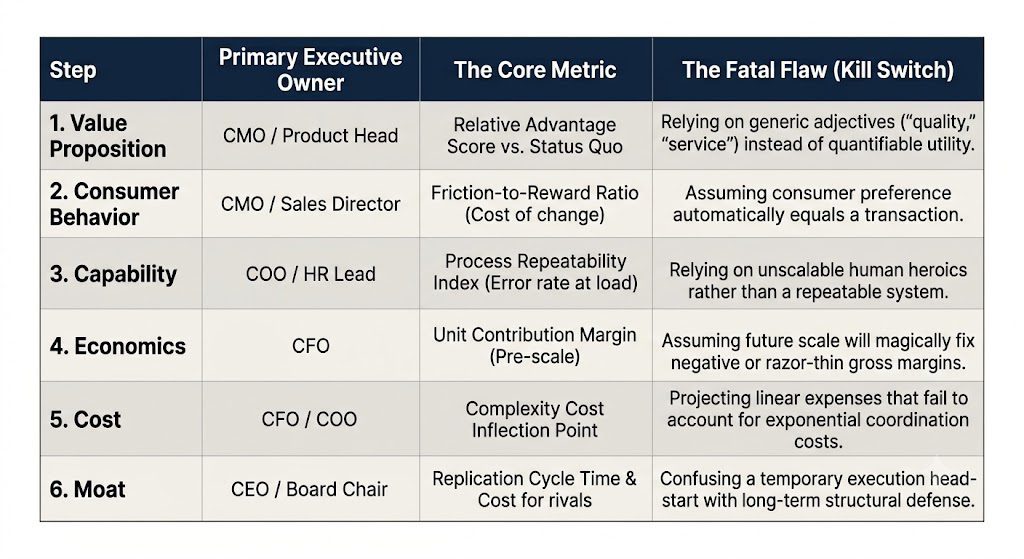
The Executive Dashboard
To bridge the gap between governance and execution, the Logic Chain serves as a cross-functional risk and growth filter. Every member of the leadership team owns a specific link in the chain:
Case Application: The Mindanao Marketing Summit
At the Mindanao Marketing Summit, I applied this architecture in an intensive session with marketing educators and business owners to stress-test real institutional and commercial strategies. Due to time constraints, we deployed a condensed version of the Logic Chain for rapid diagnostic application rather than full deep-dive validation.
Even in compressed form, the structural gaps became instantly visible:
- Value Proposition: Many organizations defaulted to generic “service excellence” or “high quality” as positioning. Without a defined, quantifiable outcome, their differentiation immediately collapsed into a price war.
- Behavior: Multiple strategies assumed customer adoption without analyzing the behavioral friction. In education systems specifically, this pattern explains the significant drop in student retention between the first and second semesters of the first year. Institutions heavily over-invest in driving the initial behavior (enrollment) but entirely fail to address the operational friction that drives early exit decisions (sustained participation).
- Economics: In multiple cases, revenue logic existed but margin logic did not.
- Cost: Scale assumptions were often linear, but cost behavior is non-linear under complexity, completely ignoring how cost behavior spikes under complex expansion.
- Moat: Very few strategies had clear defensibility. Most relied on execution quality rather than structural protection.
The Logic of Governance
The Logic Chain shifts governance from forensic accounting—asking what went wrong after the capital is gone—to structural validation. It ensures the blueprint can withstand the structural load before a single peso is deployed.
Strategy does not fail because executives lack intelligence. It fails because ideas are scaled before their underlying logic has been validated.
The most expensive mistake in business is not failure; it is scaling something that was never structurally sound in the first place.
***
Josiah Go is a business thought leader, bestselling author of 20 books in marketing and entrepreneurship, and the chair of Mansmith and Fielders Inc. He is the co-creator (with Chiqui Escareal-Go) of the PILA Framework and the Trust Economy Flywheel.