

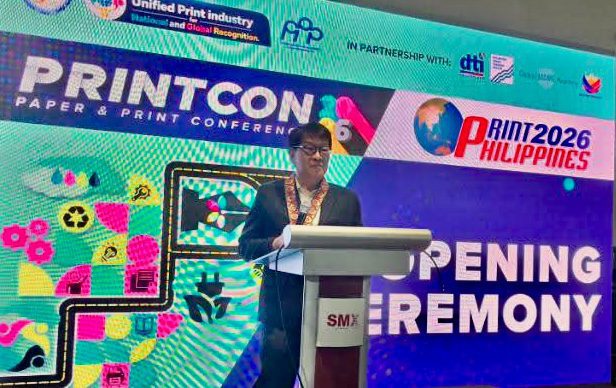
Keynote Address: PrintCon 2026
Theme: Unified Printing Industry for Regional and Global Recognition
I. The Commodity Trap
When we speak on the theme of “Regional and Global Recognition,” our minds naturally gravitate toward the physical monuments of our progress. The digital presses. The high-speed automation. The onset of Artificial Intelligence.
These are important. But we must be careful. Because in the modern world, technology is no longer a shield, it is the fastest path to commoditization.
If equipment can be bought, your competitor will buy it. If a process can be automated, your competitor will automate it. What was a distinct competitive advantage last year is merely the baseline industry standard today.
So, the existential question for this congress is simple:
What remains when the equipment, the technology, and the prices are completely identical?
I believe the answer is trust.
Trust is the only raw asset that cannot be reverse-engineered. Your competitors can copy what you do. They can never copy who you are.
They cannot duplicate a reputation built over decades, nor can they replicate relationships forged through consistent service. Trust is difficult to build, effortless to lose, and nearly impossible to commoditize.
II. Responsibility Beyond Obligation
Let me take you back thirty-four years. I was a first-time author. I possessed an abundance of ambition, but absolutely zero experience.
My very first book was produced. The printing run was finished. Everything looked flawless. Until I turned to the first page.
The final line of that page was missing. Just one sentence. One omission. But without it, the entire introduction lost its logic.
Consider the gravity of that moment. The books were already bound. The materials were spent. The financial cost was fully sunk. Legally speaking, my printer could have looked at me and said: “Josiah, we printed exactly what you submitted.” And contractually, he would have been one hundred percent correct. Most people in business would have understood if he had simply walked away.
But he didn’t.
Instead, he chose to do what was right. Not because a contract compelled him, but because his character demanded it. The work was corrected. The books were rerun. The issue was resolved.
That moment became an indelible part of my understanding of business. Not because of the cost, and not because of the inconvenience. But because it revealed a profound truth:
Trust is born the exact moment we choose responsibility beyond obligation.
For that lifelong lesson, I remain profoundly grateful to my printer, Mr. Maldwyn de Pano ofDesign Plus.
Years later, while working on my fifth book, I sent him a new cover design. A few minutes later, my phone rang. He didn’t call to report an error or ask for clarification.
He simply said: “Josiah, I’ve received your file. But before we proceed to print, I want you to look at an alternative version I designed for you.”
Think about that. He already had the contract. The transaction was finalized. His financial reward was secure. Yet he chose partnership over a mere transaction. He invested creative energy he was not required to spend. He contributed value he was not obligated to provide.
He treated my success as his own success.
That is the profound evolution of commerce: It is the shift from a supplier to a partner. And from a partner to a steward.
And stewardship is always rooted in trust.
And yes- from supplier to partner, partner to steward- and today- a friend I can always trust.
III. The Trust Economy Flywheel
For decades, I have analyzed these specific moments of corporate integrity. Eventually, this led to the development of a 7-step framework I call the Trust Economy Flywheel.
Many operating under conventional wisdom believe that trust begins with transparency. I do not. Transparency without underlying character is nothing more than public relations. It is performance.
Trust does not begin outwardly; it begins with the inner condition of the leader. What our culture beautifully defines as Loob.
This inner architecture moves through three vital dimensions.
1: Humility
It begins with Humility. Humility is not thinking less of yourself; it is seeing reality clearly. It is the rare executive capacity to ask: “What if the adjustment must begin with me?”
Maldwyn held the signed proofs. He had the legal authority to protect his profit margin. But humility allowed him to prioritize architectural truth over the protection of his position.
2: Cultural Literacy
It moves to Cultural Literacy, the acute ability to read the unspoken aspirations, values, and fears of your market.
A printer who understands only specifications prints jobs; a printer who understands culture protects brands.
3: Empathy
And it culminates in Empathy, asking the singular question: “What matters to the other person?”
4: Transparency
When the loob is aligned, it naturally crosses the bridge of Transparency. This means revealing reality even when it is financially uncomfortable. It means choosing long-term legacy over short-term convenience.
And when transparency becomes the cultural habit of an organization, it yields structural momentum:
5: Authenticity
Authenticity means people know who we really are.
When transparency is grounded in character, something changes.
We stop performing. We start becoming.
People sense alignment.
Between who we are, and what we say.
6: Consistency
Consistency means our actions align with our values repeatedly over time. Not once. Not occasionally. But consistently.
Because trust is not built by isolated actions. Trust is built by repeated behavior.
7: Accountability
And accountability means we take ownership.
This is where trust matures. The willingness to own outcomes. Not just success, but failure.
Maldwyn’s story reminds us that leadership is often tested not when things are going well, but when we are confronted by uncomfortable truths.
Different responses can lead to very different outcomes. And accountability often determines whether trust grows or dies.
Accountability does not erase failure.
It determines what failure becomes.
Authenticity in your brand, Consistency in your operations, and ultimately, absolute Accountability.
This is where the trust flywheel achieves its compounding power. Accountability is never a dead end; it is a return path.
When Maldwyn took radical ownership of that missing line, he didn’t just fix a page. That act of accountability instantly reset the loop right back to Humility. It proved he was still open to learn, to adjust, and to serve. That closed loop is precisely what transformed an operational error into a thirty-four-year relationship.
IV. The Fluency Trap
As I look across this room today, I see high-performance organizations. But as a strategist, I must issue a solemn warning regarding the Fluency Trap.
We are surrounded by leaders who are incredibly fluent. They possess gorgeous storytelling. They display beautiful marketing. They give immaculate presentations.
But when you strip away the polish and audit their underlying strategic logic, when you test their problems, their insights, their logic, and their core assumptions, you find that the core is entirely hollow.
In the printing sector, it is dangerously easy to be fluent in technology while remaining entirely bankrupt in trust. You can possess the fastest digital presses on the continent, but if your accountability vanishes the moment an operational deadline is dropped, your machinery is irrelevant.
Let me ask you the difficult question that must be answered before this conference concludes:
Where is your trust flywheel stuck?
Is it stuck at Humility? Are you too proud to admit that your internal legacy processes are outdated?
Is it stuck at Transparency? Do you intentionally conceal operational or logical defects until the client discovers them?
Is it stuck at Accountability? Do you blame someone or something else instead of owning the ultimate outcome?
V. Unity at Scale
The theme binding us together this conference is Unified. And we must recognize that unity is not a sentiment. Unity is simply Trust at Scale.
No independent company, no matter how capitalized, can single-handedly construct the global brand of “Philippine Printing.” Only an integrated industry can achieve that.
Every value chain is, at its core, a trust chain.
And every value proposition relies entirely on your value chain partners.
When the paper supplier trusts the printer, when the printer honors the publisher, and when the publisher protects the author, we construct an industrial ecosystem of high velocity and zero friction.
Maldwyn de Pano did far more than salvage a first-time author’s manuscript. He modeled an industry stewardship. He proved to us that trust always travels farther than products.
As you spend the next two days examining the future of your craft, do not merely look at the new machines on the exhibition floor.
Look into your loob.
Ask yourself: “What needs to change in me for this industry to achieve global recognition?”
Recognition is never the object we pursue directly. Recognition is merely the shadow cast by trust accumulated over time.
Let us build a unified industry that is not merely competitive, but fundamentally, unconditionally trustworthy.