
Whenever I evaluate business models, I always stress one fundamental truth: Scale does not fix flawed underlying logic; it only accelerates capital destruction.
Few market sagas illustrate this principle as vividly as the rise, collapse, and structural reinvention of China’s dockless bike-sharing boom.
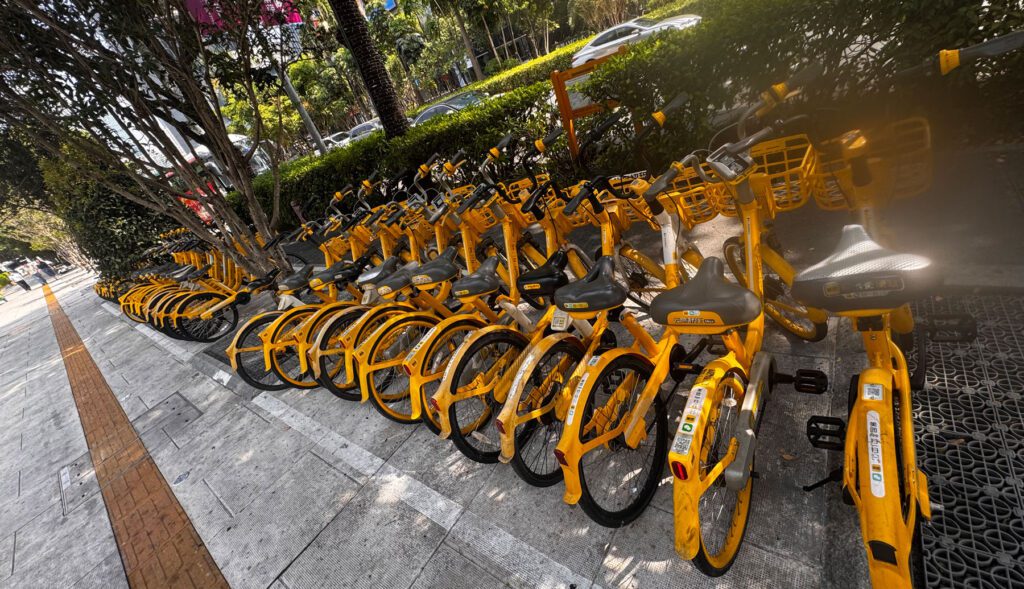
Years ago, while analyzing Asia’s tech unicorn boom, I watched venture capital fuel an unprecedented market-share war. Bike-sharing startups were proclaimed the “Fourth Great Invention of Modern China.” Fleets of brightly colored bicycles: Ofo’s yellow, Mobike’s orange, Bluegogo’s blue, flooded Beijing, Shanghai, and major metropolitan centers worldwide.

Yet within 36 months, billions of dollars in venture equity vanished. Ofo collapsed under unpaid user deposits and abandoned hardware, leaving 15 million users stranded in refund queues. Bluegogo entered bankruptcy. Millions of bikes ended up stacked in sprawling, multi-acre “bike graveyards” outside urban centers.
Why did a service with undeniable consumer demand fail so catastrophically as a standalone business?
A conventional narrative blames bad management or reckless over-competition. A deeper look through the 6-Step Strategy Logic Chain reveals that when unit economics are broken, hypergrowth does not build a market leader, it simply builds a bigger ruin.
The Strategy Logic Audit: Why the Standalone Model Collapsed
1. Value Proposition: Price Subsidies vs. Real Preference
Early bike-sharing platforms confused a heavily subsidized price point with a sustainable value proposition. To win market share overnight, Ofo and Mobike offered rides for a fraction of a cent or distributed unlimited free passes.
When your primary point of differentiation is rock-bottom pricing, you have not created genuine brand preference; you have merely commoditized your service. The true cost of customer acquisition, converting a subsidized rider into a margin-positive user, was impossibly high.
2. Consumer Behavior: Removing Friction Without Accountability
Sustainable adoption requires eliminating friction while fostering behavioral respect for the value delivered. Dockless bikes removed the friction of traditional docking stations, allowing riders to pick up and park anywhere.
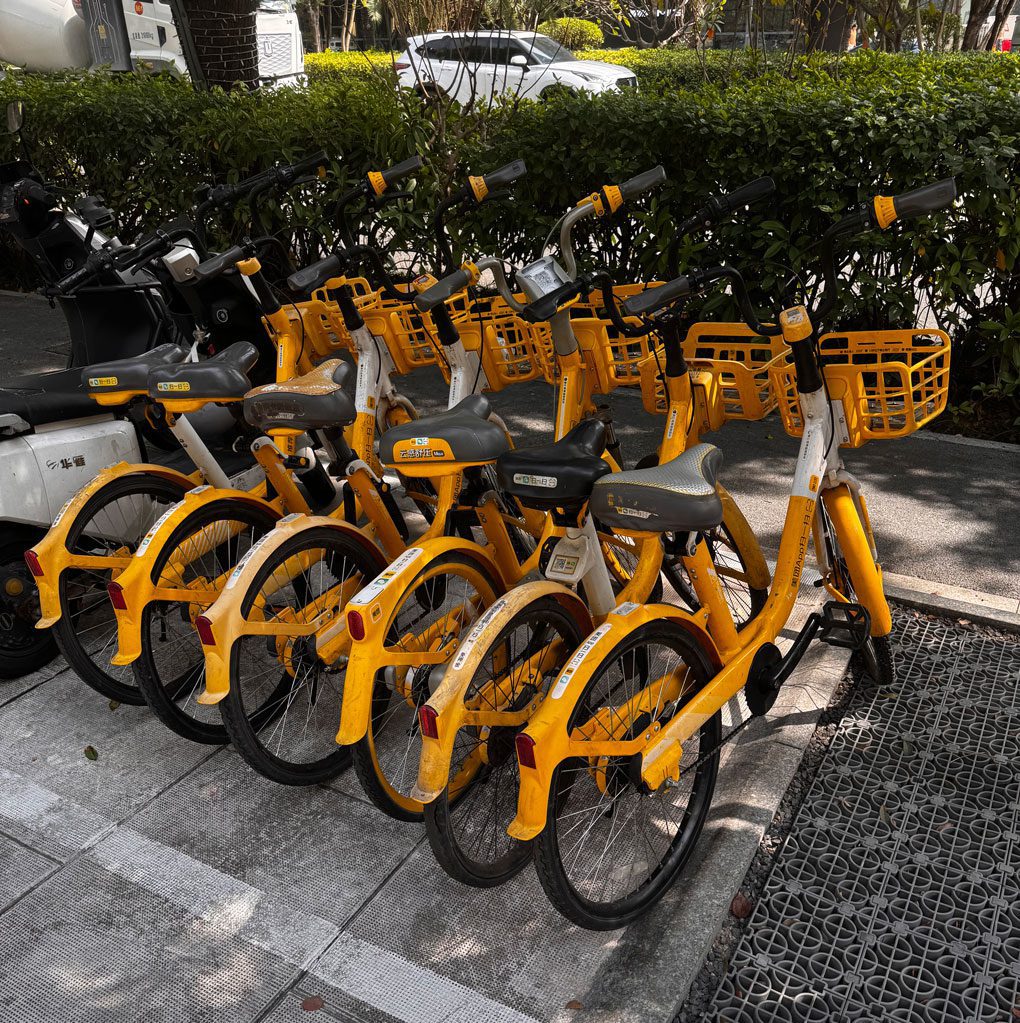
However, because rides were practically free and the assets belonged to anonymous venture-backed entities, rider behavior devolved into a classic tragedy of the commons. Without financial accountability or enforced parking zones, bikes were routinely vandalized, thrown into rivers, locked behind private gates, or discarded in chaotic heaps. This misuse systematically destroyed customer lifetime value.
3. Capability: Capital Allocation Extremes
Capability is not fleet volume; it is the repeatable, cost-effective management of core assets under load. Here, operators made opposing capital allocation errors:
- Ofo’s Low-Cost Model: Ofo deployed cheap, US$30 mechanical bikes with basic locks and airless tires. Lacking GPS tracking, these bikes degraded within three to six months, destroying themselves faster than their financial payback period.
- Mobike’s High-CapEx Model: Mobike engineered sturdier US$300 aluminum-alloy bikes featuring GPS smart locks and shaft drives. While durable, their high upfront capital expenditure required an unrealistic, virtually unreachable daily ride frequency just to break even on hardware costs alone.
Both models failed the payback race from opposite ends of the spectrum.
4. Economic Drivers: Bleeding on Every Transaction
You cannot make up for a negative contribution margin simply by increasing transaction volume. At the single-ride level, every transaction lost money.
If a bike generated one yuan per day in fare revenue, but the combined daily cost of truck rebalancing (collecting bikes from low-density areas and moving them to transit hubs), field maintenance, cellular data for smart locks, and asset depreciation totaled two and a half yuan, the daily operating contribution margin was deeply negative.
To mask these structural losses, operators relied on refundable user deposits, treating customer liabilities as interest-free working capital to fund fleet expansion. When operational losses drained liquidity and user growth slowed, deposit runs triggered immediate insolvency.
5. Cost Structure: The Complexity Trap
As operators dumped millions of extra bikes into Tier-1 cities to choke out rivals, system costs exploded exponentially rather than achieving economies of scale. Street clutter forced municipal governments to impose strict fleet quotas, impound illegal bikes, and levy heavy fines. Shuffling thousands of bikes across sprawling urban centers wiped out whatever operating leverage remained.
6. Moat: Zero Switching Costs
As a standalone product, a free-floating bicycle carries zero moat. There is no asset differentiation and no brand loyalty for a commuter stepping out of a subway station; they simply unlock whichever bike stands closest to the exit. When an asset has zero switching costs, competition degenerates into a brutal war of capital attrition.
The Strategic Pivot: How Ecosystems Rescued the Economics
Why are Chinese city streets still filled with shared bikes today? Because the sector underwent an aggressive consolidation that completely reframed the job-to-be-done of micro-mobility.
Today, China’s micro-mobility sector is dominated by an oligopoly embedded within major tech super-apps:
- Meituan Bike serves as a low-cost entry point into food delivery and local lifestyle services within the broader Meituan app ecosystem.
- Didi Qingju operates as a last-mile feeder network for Didi’s primary ride-hailing system.
- Hellobike focused on Tier-2 and Tier-3 cities, integrating deeply with Ant Group’s Alipay for digital payments and user onboarding.
Instead of treating bikes as standalone profit centers, these platforms utilize micro-mobility as a high-frequency, low-cost customer acquisition channel.
Furthermore, operators expanded into shared electric mopeds, commanding higher fares with healthier unit contribution margins. By integrating credit scoring platforms like Alipay’s Sesame Credit, they eliminated cash deposits entirely, removing financial risk while preserving user trust.
The Future of Micro-Mobility and Implications for Business
Looking ahead, micro-mobility is evolving away from venture-subsidized fleet dumping toward deeply integrated, multimodal smart-city networks. Future transport architectures will likely link public transit, autonomous vehicle feeds, and light electric vehicles under unified routing platforms, governed by predictive AI geofencing and dynamic, demand-responsive pricing.
For business leaders and startup founders, the implications across all industries are clear:
- Protect Unit Economics First: Never build a scaling strategy on negative contribution margins with the vague hope that scale will solve unit losses.
- Anchor Low-Margin Commodities to Ecosystems: Standalone low-margin offerings must connect to higher-margin service ecosystems that can effectively capture downstream lifetime value.
- Align Asset Lifespan with Payback Periods: Core physical and digital assets must comfortably outlive their payback requirements under worst-case operational friction.
Assumption Governance and the “Option Trade” Gamble
Looking back, was the bike-sharing crisis purely a failure of strategic foresight, or was it a calculated gamble that got out of hand?
From an investor’s vantage point, early hyperfunding was essentially a high-stakes option trade. Venture capital firms were not underwriting a modest bike rental operation; they were buying a multi-billion-dollar call option on capturing the ultimate mobile traffic gateway for Asian super-apps.
The strategy failed because founders and investors treated a high-stakes option trade as if it were a linear operational business model, burning billions without enforcing boardroom risk stops.
This collapse could have been managed, or avoided, if leadership had instituted formal Assumption Governance.
In boardrooms, unbridled optimism often disguises unverified assumptions as facts: “Riders will respect unmonitored property,” “Municipalities will tolerate unchecked public clutter,”and “Scale will automatically turn negative margins positive.”
Boardroom Risk Directives
To protect capital, boards must enforce two specific oversight mechanisms:
- Maintain an Explicit Assumption Register: Document every core belief driving customer behavior, asset durability, and regulatory compliance alongside quantitative validation targets.
- Tie Capital Tranches to Assumption Milestones: Require management to stress-test key operational assumptions on a micro-scale before releasing capital for hyper-scaling. If asset destruction rates or rebalancing costs breach acceptable thresholds, expansion must pause immediately.
Scale amplifies whatever logic you feed it. Enforce explicit governance over your strategic assumptions before pushing the accelerator on growth.