
In business strategy, we often obsess over price elasticity—the mathematical relationship between cost and demand. But as we navigate the complexities of 2026, the marketplace is being reshaped by a far more volatile force: The Psychology of Uncertainty.
Uncertainty is often more damaging than an actual price increase. While a price hike is a known variable one can budget for, uncertainty triggers precautionary savings.
Even consumers who can afford to spend may stop doing so out of fear of a “terminal limit” or a future crash. This “wait-and-see” attitude creates a self-fulfilling prophecy of economic cooling.
I experienced this firsthand during a recent trip to Marketplace Opus. I went in as a shopper, but I came out as a strategist. What I observed in my own cart, and in the behavior of those around me, was a sophisticated execution of what I call the Architecture of Prudence.
The Core Framework: Why Prudence, Why Now?
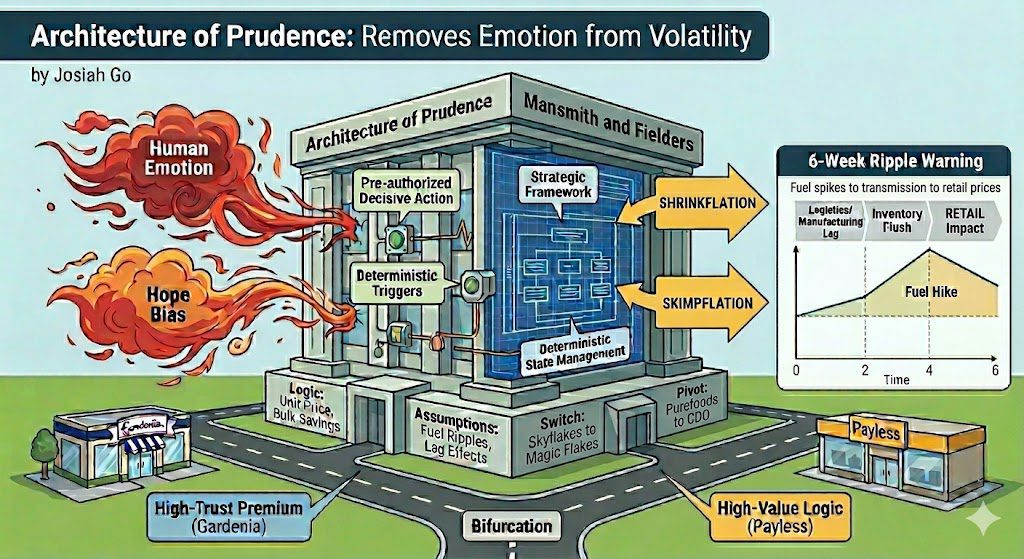
The Architecture of Prudence is a strategic framework designed to remove “human emotion” and “delayed reaction” from critical decision-making. It is built on the insight that in times of extreme volatility, whether in a stock market crash or a household budget crisis, human beings are prone to “Hope Bias.” We hope the market will bounce back; we hope prices will drop next week.
This bias leads to paralysis. In 2026, where digital-speed volatility is the norm, “hope” is a dangerous strategy. For the “Household CEO,” this architecture is critical because it replaces emotional hesitation with deterministic action. These consumers aren’t just “being cheap”; they are building a defensive wall around their family’s quality of life. By establishing clear logical triggers and staying ahead of inflationary assumptions, they decide exactly when to pivot their consumption before the crisis hits their bottom line.
1. Redefining the Must-Haves
When disposable income feels threatened, the boundary between “Needs” and “Wants” moves. Consumers don’t just stop spending; they edit.
- The “Laggard” Effect on Durables: We are seeing a massive shift in big-ticket items. Consumers are prone to delaying new car or appliance purchases, moving instead into a “Repair vs. Replace” mindset. If you sell new goods, your biggest competitor isn’t another brand; it’s the local repair shop.
- The Power of the Bundle: I found myself reaching for Magic Flakes instead of the usual Skyflakes. Why? A “10+1” bundle pack caught my eye. I remembered my nephew, a former brand assistant at URC, once told me “apat dapat,” and that mental anchor, combined with a superior unit price, triggered a brand switch.
- The Breadwinner’s Choice: Even in essentials, I noticed shoppers gravitating toward Gardenia. In times of uncertainty, a brand that represents consistent freshness acts as a psychological safety net. People may cut back on steak, but they won’t compromise on the quality of the loaf that feeds the family.
Marketing Insight: Being “Top of Mind” is useless if you are “Out of Budget.” If your brand doesn’t justify its premium through clear functional superiority—the way Mega Sardines does with “freshly caught” or Datu Puti does with heritage consistency—you are a prime target for substitution.
2. The Logic of Substitution: From Brands to Categories
As prices rise, the defensive maneuver becomes tiered. I initially reached for Purefoods corned beef because of a “Buy 2, Save P10” pack. But then I paused and replaced it with CDO. Why? Because CDO is a reliable brand with a consistently reasonable price that doesn’t rely on “price-off” promos to prove its value.
Then, I went a step further: I shifted volume to San Marino corned tuna. This was a Category Substitution. I realized tuna offered better value for money and health benefits compared to the rising cost of beef. Similarly, I added Jolly canned vegetables to my cart. When fresh produce prices fluctuate due to logistics, a reliable canned brand offers price-locked nutrition and convenience that fresh greens currently can’t match.
3. Behavioral Coping: The Consumer as Logistics Manager
In uncertain times, consumers become their own Supply Chain Officers. They optimize “last-mile” logistics to protect the household bottom line.
- Batching & Carpooling: My wife, Chiqui, and I recently attended a painting exhibition and decided to carpool. Efficiency isn’t just a corporate buzzword; it’s a household survival tactic.
- The Gas vs. Delivery Calculus: Consumers are now performing a mental audit: Is the delivery fee cheaper than the fuel, parking, and time required to drive to the store? If your retail footprint isn’t optimized for this “new logistics,” you are invisible.
4. The Surge of the “Unbranded” and Community Trust
There is a migration toward House Brands and community-sourced goods. The danger for premium marketers is the “Stickiness” of this shift. Once a consumer realizes a store-brand detergent or a neighbor’s unbranded eggs are “good enough,” they rarely switch back.
My driver mentioned a neighbor selling unbranded eggs. We asked him to replenish our inventory. With a household staff of caregivers, helps, and a driver, our “organizational” consumption is high. My wife now orders food for the staff from a regular supplier, but we source eggs locally for their breakfast. I trust my neighbor to take care of us. This bond of Community Business creates a barrier that advertising cannot break. Even in Mercury Drug, my instinct is now to ask for RiteMed. The “Price vs. Trust” barrier for generics has been shattered.
5. The Bifurcation of Shopping: The “Middle” Graveyard
We are seeing a clear architectural split in how different income groups handle liquidity. In a bifurcated market, the middle is a graveyard; you must either be the high-trust premium (Gardenia) or the high-value logic (Payless).
- Middle-Income groups are moving to bulk-buying to lower their long-term unit costs. They have the cash flow to “invest” in inventory.
- Low-Income groups are moving to a “Micro-dose Economy.” I asked some workers where they shop and eat; they’ve moved to discounters, and eat more often in canteens or supermarket stalls. They can’t afford the unit-cost savings of bulk; they buy only what they need for the next 24 hours.
The “Payless” Lesson: I saw Payless noodles—128g at P17+ versus Lucky Me’s 120g at P19+. In this economy, “Payless” is a brilliant brand name. I decided to try them. Perhaps I’ll get luckier if I pay less.
6. The “6-Week Ripple” and the Trap of “Flation”
Fuel is the “hidden ingredient” in almost everything. It typically takes about 4 to 6 weeks for a fuel spike to flush through the supply chain and hit the grocery shelf.
This is the critical window. Marketers who don’t use this 6-week window to reinforce their value proposition will find themselves playing defense when the price tag finally changes. During this lag, brands often resort to two dangerous tactics: Shrinkflation (reducing quantity) and Skimpflation (using cheaper ingredients). Consumers are not blind to this; when you skimp on quality, you aren’t just protecting your margin; you are eroding your brand equity.
Honor the Institution
As we head into this Holy Week, I’ve been reflecting on how trust and accountability intersect in leadership. Building an “Architecture of Prudence” isn’t about being “cheap”—it’s about being accountable to the institutions we serve, whether that is a corporate board or a family household.
Whether it’s sticking to a brand because of a “freshly caught” promise (Mega), a heritage of consistency (Datu Puti), or switching to a neighbor’s eggs to support the community, consumers are defining what “Value” means to them in real-time.
Marketing Insight: Don’t just watch the price index. Watch the psychology. If you don’t provide a “Plan B” for your customers’ shrinking disposable income, they will build one without you.
***
In a marketplace defined by volatility, “business as usual” is the fastest route to irrelevance. The Architecture of Prudence is not just for the grocery aisle; it is a fundamental requirement for the modern executive.
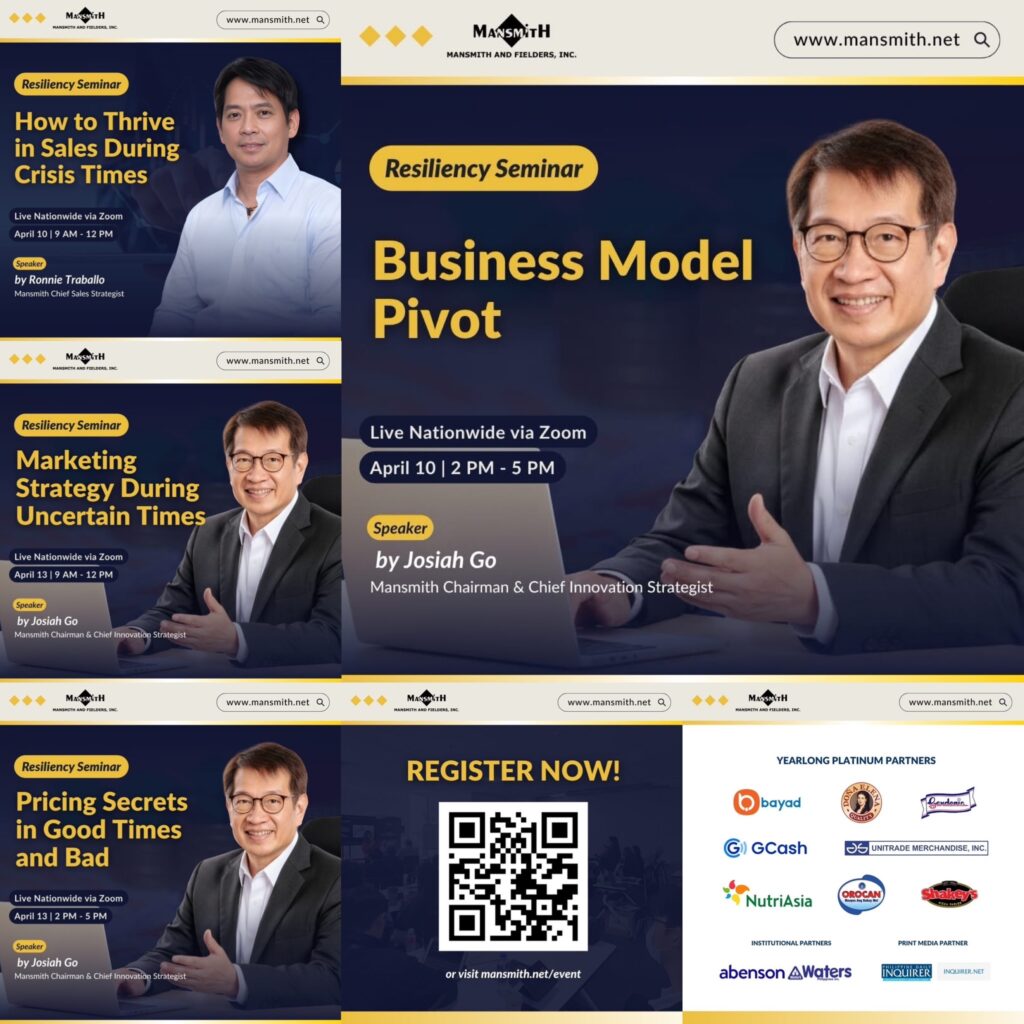
To deep-dive into these frameworks and master the strategic maneuvers needed to navigate 2026, I invite you to join us for our upcoming Marketing Resiliency Seminars on April 10 and 13, 2026. We will decode the “unthinkable” scenarios of today and equip you with the tools to not only survive but thrive during these uncertain times. Best of all, Abenson and Waters Philippines are providing a 50% subsidy so you only pay P2,500 +vat per participant.
Secure your seat by emailing info@mansmith.net. Let’s build resilience together.