

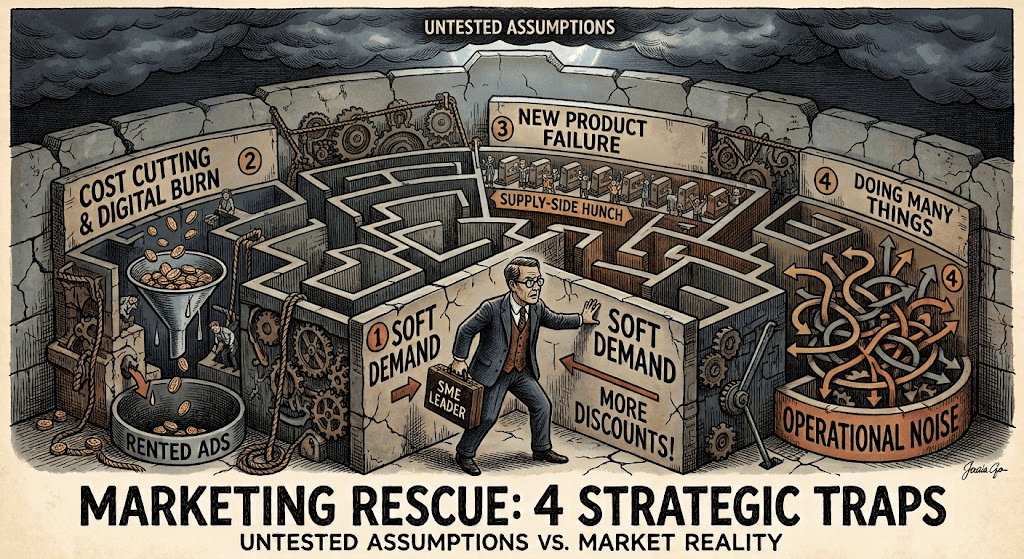
In recent sessions of our Marketing Rescue free consulting program at Mansmith and Fielders, we have observed a recurring pattern among business owners and founders.
Sales are slowing. Customer acquisition costs are rising. New product launches are underperforming. In response, management teams are working harder, spending more, and launching more initiatives.
Yet revenue remains flat, margins continue to shrink, and people are burning out.
The problem may not be a lack of effort. It may be that the business is doing more of the wrong things.
Under pressure, executives often fall into operational hyperactivity: accelerating existing activities without first questioning whether the underlying strategy is sound.
But speed is an amplifier, not a cure. If your assumptions are wrong, faster execution can simply accelerate the deterioration of your business.
Across our Marketing Rescue diagnostic sessions, one lesson repeatedly emerges: business problems are often prolonged not by a lack of action, but by assumptions that leaders accept as facts without testing them.
Here are four common traps, and the strategic shifts that can help business owners break free.
Trap 1: Soft Demand: Discounting vs. Creating Value
- The reflex: When sales decline, management cuts prices, launches flash sales, or offers deeper trade discounts.
- The untested assumption: Our sales are falling because customers think we are too expensive.
- The problem: Weak demand does not automatically mean a price problem. Customers may not understand the value proposition, may see little differentiation from competitors, or may simply have more urgent priorities. Discounting before diagnosing the problem is a costly shortcut. It sacrifices margin without necessarily addressing the reason customers are not buying. Worse, repeated promotions can condition customers to wait for the next sale, weaken price expectations, and leave the business with less money to invest in product improvement and growth.
- The Marketing Rescue: Diagnose before you discount. Determine whether customers are rejecting the price, questioning the value, choosing a competitor, or postponing the purchase altogether. Examine conversion rates, customer objections, and willingness to pay before changing your pricing strategy. If the problem is perceived value, lowering the price may only reinforce the wrong message. Strengthen the value proposition instead. Make it clear what problem you solve, why your offer is different, and why that difference matters to your target customer now. The objective is not to be the cheapest option. It is to be worth the price you charge.
Trap 2: Digital Ad Burn: Buying Transactions vs. Building Customer Relationships
- The reflex: As customer acquisition costs rise across digital advertising networks and e-commerce platforms, management increases ad spending to sustain sales.
- The untested assumption: Paid advertising is the engine that will keep our business growing.
- The problem: Paid media can be an effective acquisition tool, but relying on it to generate every subsequent transaction can undermine profitability. When a business must repeatedly pay to reach customers it has already acquired, it risks becoming dependent on rented attention. Revenue may grow while acquisition costs consume an increasing share of the margin. The critical question is whether those orders contribute to profitable, sustainable customer relationships.
- The Marketing Rescue: Separate acquisition economics from retention economics. Use paid media strategically to reach new customers and generate demand. Then create reasons for customers to return through relevant offers, excellent customer experiences, loyalty initiatives, and direct communication. Build an owned customer ecosystem where appropriate: a consent-based customer database, email and messaging channels, and a direct digital presence. These assets can help you nurture relationships without depending entirely on paid reach. Track cost of customer acquisition cost (COCA), contribution margin, repeat-purchase rates, and customer lifetime value (CLTV). Do not celebrate sales growth without understanding the cost of generating it. The goal is not to eliminate advertising. It is to ensure that every customer acquired has the potential to contribute to long-term profitability.
Trap 3: Failed Product Launches: Internal Capability vs. Customer Demand
- The reflex: When a new product or line extension fails to gain traction, management responds with more promotions, influencer campaigns, and social media spending.
- The untested assumption: If we can make a good product, customers will eventually buy it.
- The problem: A product can be well designed, technically sound, and efficiently manufactured, and still have no compelling reason to exist in the customer’s life. In our consultations, we sometimes ask founders: Why does your target customer need this product? What specific problem does it solve, and what would the customer lose if it were no longer available? The answers can be revealing. Some products originate from excess factory capacity, attractive supplier deals, available technology, or management’s enthusiasm for an idea. These may be legitimate starting points for innovation, but they are not evidence of market demand. A company’s ability to produce something does not establish a customer’s willingness to buy it.
- The Marketing Rescue: Start with demand, not production. Ask what job the customer is trying to accomplish, what frustration remains unresolved, and what alternatives the customer currently uses. Validate the answers through customer interviews, behavioral evidence, competitive analysis, and small-scale market tests before committing substantial resources. Do not confuse customer compliments with purchase intent. Positive feedback is encouraging; actual buying behavior is stronger evidence. If a product cannot establish a meaningful reason to be chosen, increasing its promotional budget may only make an unproven proposition more expensive to sell. Marketing cannot permanently compensate for a product that lacks sufficient relevance. First establish why customers should care. Then scale your efforts to reach them.
Trap 4: Operational Burnout: Activity vs. Strategic Leverage
- The reflex: Management launches more projects, opens additional social media channels, taps more influencers, introduces secondary promotions, and makes minor product changes in the hope that something will restart growth.
- The untested assumption: If everyone stays busy, the business will move forward.
- The problem: Activity and progress are not the same thing. An organization can have full calendars, multiple campaigns, and exhausted employees while making little progress on revenue, profitability, or customer retention. The underlying issue is often a failure to distinguish between activities that create measurable business value and those that merely create the appearance of momentum. Every new initiative consumes resources. The cost is not limited to its budget; it also includes management attention, employee capacity, and the opportunity to pursue something more valuable.
- The Marketing Rescue: Identify the few activities that create disproportionate value. Ask your leadership team: Which initiatives are demonstrably improving revenue, contribution margin, customer retention, or another critical business outcome? Which activities consume time and money without producing meaningful results? Prioritize based on evidence, not organizational habit or executive enthusiasm. Stop, simplify, or redesign initiatives that do not advance the strategy. This does not mean doing less for its own sake. It means concentrating resources where they can make the greatest difference. The objective is not to keep everyone occupied. It is to make the organization more effective at producing results.
Four Questions Before You Spend More
Before cutting prices, increasing advertising budgets, launching another product, or adding more initiatives, challenge the assumptions behind your decisions.
Ask four questions:
- Demand: Are customers rejecting our price, or do they fail to see enough value in our offer?
- Acquisition: Are we building profitable customer relationships, or repeatedly paying to generate transactions?
- Product: What evidence demonstrates that customers genuinely need or want what we are selling?
- Execution: Which activities measurably improve business performance, and which merely keep our teams busy?
These questions may seem simple. But answering them honestly can require more discipline than approving another campaign or launching another promotion.
When performance weakens, the pressure to act is understandable. Leaders are expected to respond, teams want solutions, and shareholders expect results.
But urgency should not exempt assumptions from scrutiny.
Sometimes the most expensive mistake a business can make is not failing to act quickly enough. It is committing more resources to a strategy that has not been properly questioned.
Before asking your people to move faster, make sure you are solving the right problem.
Because when the underlying assumption is wrong, doing more will not necessarily get you more. It may simply cost you more.
***
Josiah Go is an entrepreneur, bestselling author, award-winning business educator, and independent director of a bank. Together with anthropologist Chiqui Escareal-Go, he will speak at the Mansmith Prosperity Forum on November 25, 2026, covering business model pivots, reasoning stacks, and trust-based leadership. To attend this subsidized event, email info@mansmith.net.