
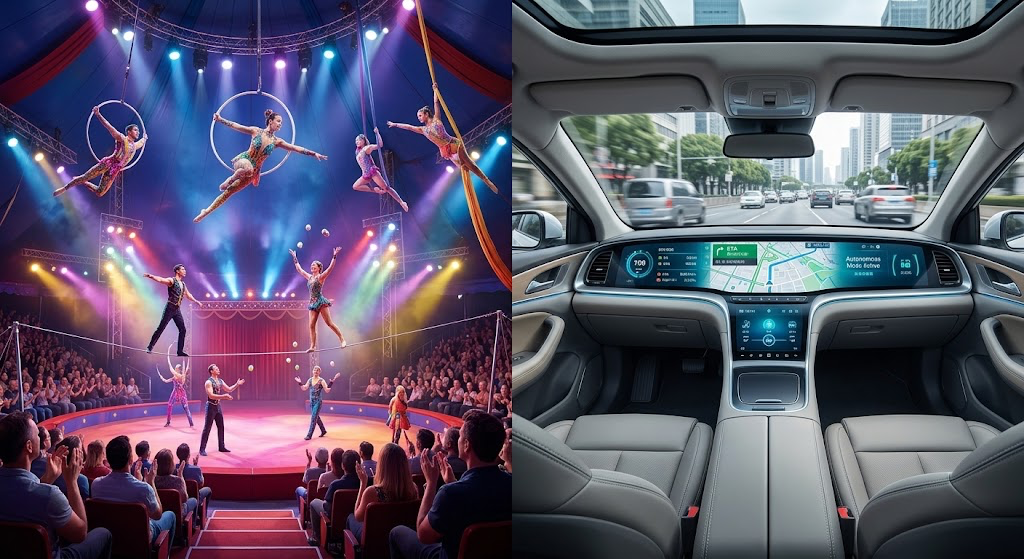
When Cirque du Soleil reimagined the circus in the 1980s, they didn’t just tweak an old show, they executed a classic Blue Ocean shift.
They eliminated live animals, which accounted for roughly 60% of traditional circus operating costs and carried massive transportation, housing, and veterinary burdens. They did not simply pocket those savings as passive margin; they reinvested them into theatrical production, original music, and elite acrobatic talent. In doing so, they created an entirely new, high-margin category: sophisticated adult entertainment.
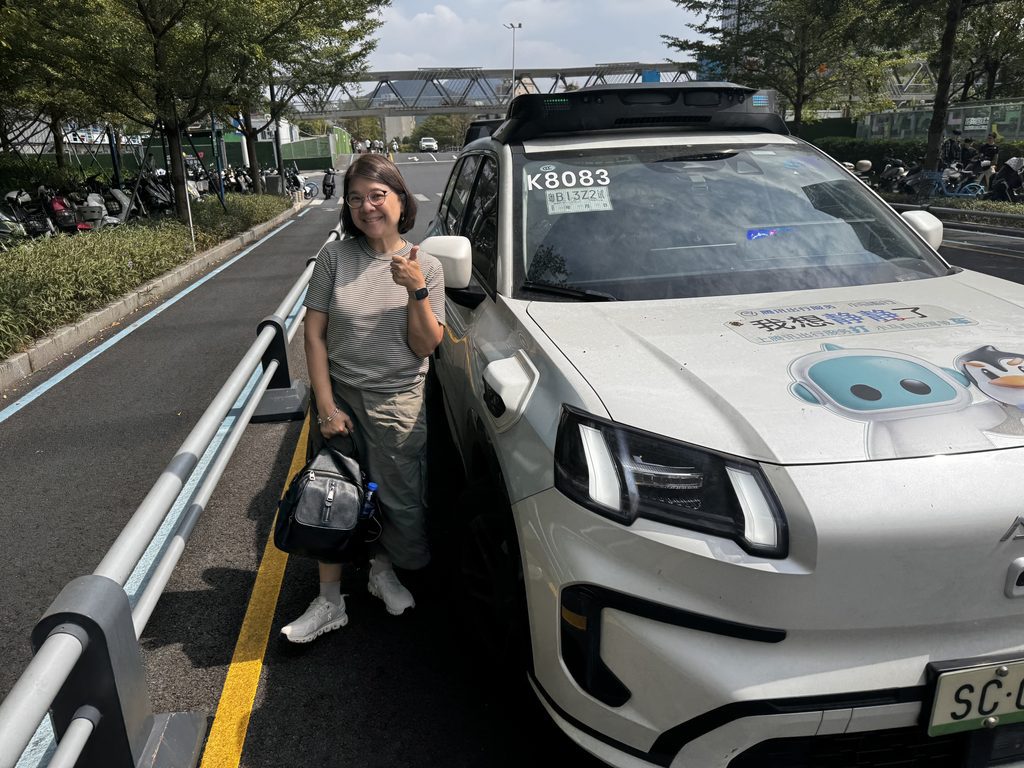
On our second day in Shenzhen, Chiqui and I hired a local guide to take us deep into the city’s autonomous vehicle test zones and commercial hubs. Riding in and observing fully driverless robotaxis navigate multi-lane traffic without a human safety driver made the strategic parallel unmistakable: driverless cabs are executing the exact same Blue Ocean structural maneuver on urban transport.
1. Strategy Logic Chain Analysis: Driverless Cabs
- Value Proposition: Delivering safe, private, and consistent urban transit. However, pricing expectations require an immediate reality check. Initial consumer hype is driven by extreme promotional subsidies (first-time rides offered for mere pennies). Once normalized, real-world commercial fares closely align with conventional ride-hailing rates. Taking a robotaxi for a 12-kilometer trip from Shenzhen Bay Street to the DJI Headquarters cost us RMB 23.8 (US$3.45) proving that the sustainable value proposition is not artificial rock-bottom pricing, but price-parity accompanied by a superior private cabin experience.
- Consumer Behavior: Booking happens natively within familiar ecosystems. As our guide demonstrated during our field trips, passenger expectations quickly shift from evaluating “driver ratings” to expecting a standardized, quiet, and private cabin environment
- Capability: Requires a Level 4 multi-sensor stack (LiDAR, radar, cameras) integrated with municipal Vehicle-to-Everything (V2X) infrastructure, where smart traffic signals broadcast timing windows directly to the onboard compute unit.
- Economic Drivers: Driven by asset utilization. A personal car sits idle 95% of the day. A robotaxi operates 20+ hours daily, maximizing paid-mile ratios while minimizing empty “deadhead” miles.
- Cost Structure: Human driver payouts traditionally consume 50% to 70% of a ride-hail fare. Removing the human driver shifts the financial model from variable labor expenses (OpEx) to amortizing high upfront hardware and sensor CapEx over hundreds of thousands of commercial miles.
- Strategic Moat: Protected by localized regulatory approvals, such as Shenzhen’s district-wide commercial driverless permits, and millions of miles of hyper-local edge-case driving data. However, as our guide pointed out, a moat is constrained by geography and social license. Operators cannot deploy universally; both Shenzhen and Wuhan strictly confine robotaxis to designated operational zones. Furthermore, managing social and regulatory friction is paramount. In Wuhan, severe pushback from traditional taxi driver associations over income loss, coupled with high-profile technical gridlocks, such as mass vehicle-stalling incidents, prompted heightened government scrutiny, temporary permit suspensions, and mandatory safety reviews by national ministries.

2. Human Talent vs. Hardware: Two Divergent Paths
While both Cirque du Soleil and Robotaxi platforms eliminated their industry’s 60% cost anchor, they reinvested those savings into opposite economic engines:
- Cirque du Soleil (High-Value Human OpEx): Traded animal upkeep for world-class acrobats, custom music, and permanent venue residencies. Labor costs per performer went up, but show utilization soared inside permanent indoor theaters, unlocking high ticket pricing power.
- Robotaxis (Fixed CapEx): Traded variable driver labor for high-compute AI chips, solid-state LiDAR, and sensor suites. A sensor-and-compute stack carries high initial CapEx, but when amortized over 300,000+ commercial miles running 20+ hours a day, the hardware cost per mile drops to a small fraction.
3. Multi-Order Thinking: First, Second, and Third-Order Effects
In strategic planning and decision-making, evaluating an innovation solely by its immediate outcome is a dangerous form of short-sightedness.
True strategic leadership requires looking beyond the immediate splash of a new technology to map the multi-layered ripples that ultimately redefine competitive advantage.
- First-Order Effect (Direct Benefit): Direct elimination of human driver variance and structural shift from labor OpEx to hardware CapEx.
- Second-Order Effect (Systemic Market Realignment): As pricing normalizes post-promotions, market adoption faces real-world tension. Labor displacement triggers pushback from incumbent driver unions, as demonstrated in Wuhan, forcing regulatory pauses. Simultaneously, as private car ownership declines, parking structures, street parking lanes, and gas stations get converted into housing, green parks, and commercial real estate.
- Third-Order Effect (Macro Societal Shifts): Cities face revenue declines from parking fines, traffic violation tickets, and registration fees, accelerating a pivot toward per-mile road-usage taxes. Low-ridership bus routes get replaced by autonomous shuttles, while high-capacity trains become core trunks fed by robotaxi first-mile/last-mile networks.
4. The New Category: “The Private Mobile Space”
Cirque du Soleil stopped competing with traditional circuses and began competing with Broadway theater. Robotaxi operators are no longer just competing with traditional taxis; they are establishing an entirely new category: The Private Mobile Space.
Traditional transit has historically been evaluated on a narrow set of operational metrics: driver ratings, pickup wait times, vehicle cleanliness, and surge pricing splits. By permanently removing the non-family driver from the cabin, the automobile transforms from a simple point-A-to-point-B transport utility into a customizable,private room on wheels.
This structural evolution opens up uncontested market space across multiple high-margin consumer use cases. Vehicles can be specialized into mobile executive offices equipped with secure connectivity for private work and video calls, mobile entertainment suites optimized for gaming and cinema, or reclining wellness and rest pods designed for quiet, restorative commutes. By shifting the competitive arena from driver management to cabin experience, autonomous platforms create a brand-new Blue Ocean for high-margin, mobility-based experiences.
5. Reflections for C-Suites
Rather than asking when autonomous fleets will arrive in your market, organizations must ask four structural questions today:
- The Category Trap: Are we still competing in the old category of ‘cheap point-A to point-B transport,’ or are we designing business models around the ‘Private Mobile Space’?
- The Margin Anchor Audit: What percentage of our current revenue model relies on taking a commission from variable human labor that an autonomous platform can systematically undercut?
- The Social & Regulatory Moat: How are we managing the social disruption and labor friction that inevitable automation brings, as seen in Wuhan’s driver pushback, before regulatory interventions freeze our deployment?
Pivot Before the Squeeze
Scale cannot fix flawed underlying logic; it merely accelerates capital loss. For legacy taxi platforms, fleet operators, and transit authorities, defending a variable-labor model against an autonomous platform operating with near-zero marginal operating cost is a losing battle.
Rather than engaging in a suicidal “race to the bottom” against automated fleets that do not require sleep, health insurance, or hourly wages, the incumbent operator must completely rethink its Strategy Logic Chain.
***