

Our two strategic reflections on The Pilate Trap sparked a vital conversation about the modern executive’s struggle with strategic courage. The feedback was clear: you want more than a moral lesson; you want a diagnostic for leadership failure. In response, we are launching a series to decode the archetypes of organizational risk.
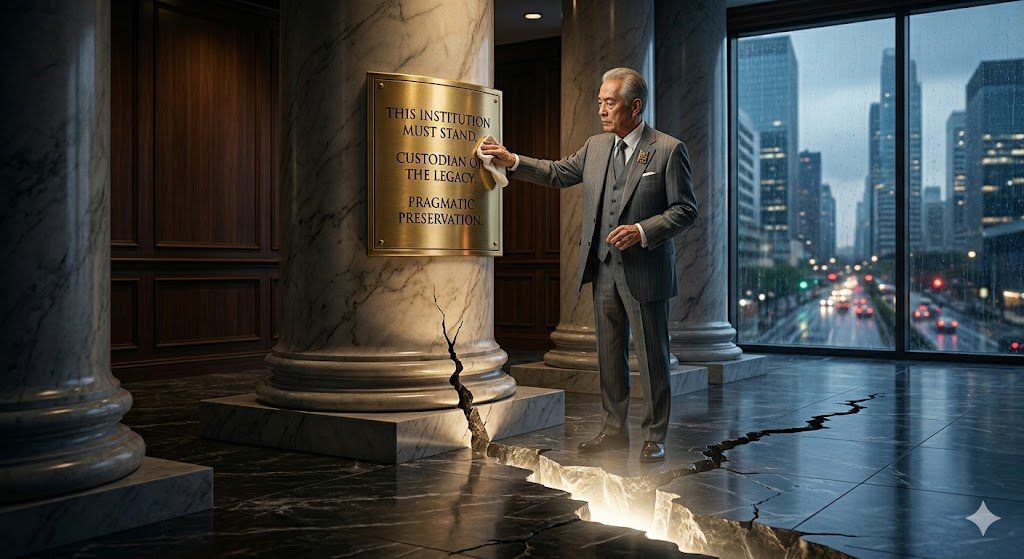
If Pontius Pilate was the regional managing director of moral cowardice—yielding to the crowd despite knowing the truth—this time, we examine his counterpart: Caiaphas, the high priest, presiding officer of the Sanhedrin (the supreme council), and architect of institutional preservation.
While Pilate’s failure was one of the heart (cowardice), Caiaphas’s failure was one of the mind. He represents the downward pressure of pragmatism that emerges when an organization values its structure over its purpose. He is the most dangerous type of leader: one who is logically consistent but morally bankrupt. Caiaphas did not think he was being “bad”; he thought he was being pragmatic. He believed that sacrificing an outlier was the fiduciary act required to save the nation from Rome.
Using the PILA reasoning stack (Problem, Insight, Logic, Assumptions), we can decode the mind of a custodian who sacrifices truth to preserve the status quo.
The Problem: Are You Solving the Problem or Only the Symptoms?
The quality of any outcome is dictated by how a leader defines the problem.
For Caiaphas, the problem was never, “What is the truth about this man?” Instead, he defined it purely in terms of asset preservation.
He famously reasoned:
“It is better for one man to die for the people than for the whole nation to perish” (John 11:49–50).
In his mind, he was solving for national survival. In reality, he was treating a symptom, civil unrest, rather than confronting the underlying reality of a shifting world.
This is the Caiaphas Trap: when a leader defines the preservation of the “structure” as the primary objective, they lose the ability to see the truth.
The Insight: Is Your Insight Forcing a Trade-off for the Better?
A strategic insight requires seeing beyond surface-level noise. Caiaphas correctly recognized that Jesus was a disruptor, but his insight was narrow and defensive. He did not see transformation; he saw a threat to the Temple’s operating logic.
Caiaphas forced a trade-off: the life of one man for the stability of the institution. But was it a trade-off for the better?
By choosing stability over truth, he chose stagnant peace over necessary transformation. He mistook a pivot for a coup, and in doing so, missed the opportunity to lead the very change the people needed. He focused on “eliminating the threat” rather than understanding the shift itself.
The Logic: Is Your Logic Sound, or Have You Silenced the Outliers?
The logic Caiaphas used to reach his verdict was built on a fundamentally compromised process. This was the deeper tragedy of the Sanhedrin: it was not just that truth was ignored, the system itself had been conditioned to prevent it from surfacing.
When a system rewards consensus and punishes dissent, its logic becomes a closed loop.
Caiaphas demonstrates that a leader operating within an echo chamber is not truly making decisions, they are executing a script. By silencing the outlier, the system protects the institution but forfeits its soul.
The Assumptions: Are You Ignoring the Second-Order Effects?
Every PILA stack rests on a set of assumptions. Caiaphas operated on the flawed belief that removing the source of disruption would end the disruption itself.
He made an undefined bet: that the execution of Jesus would restore the Temple’s status quo.
What he failed to anticipate were the second-order effects. He did not account for the reality that while you can eliminate a person, you cannot eliminate the resonance of a truth that has already taken root.
A Truth-Teller’s Diagnostic for Caiaphas
If we were to sit across from Caiaphas today, we would ask four questions:
- Problem: Are you solving the root problem or merely managing symptoms?
- Insight: Is your insight leading to a trade-off that creates a better future?
- Logic: Is your logic truly sound, or have you silenced the outliers who could correct your course?
- Assumptions: Are you making decisions without accounting for second-order effects?
The Leadership Settlement
Caiaphas kept his title as high priest, and the Temple stood for a few more years.
But he failed the test of history.
He saved the structure, but lost the architect.
The lesson for any leader is sobering: if the logic of your decision requires the sacrifice of truth to preserve the institution, then your logic is fundamentally broken.
For further reading on PILA, see:
https://josiahgo.com/pila-why-integrated-thinking-wins-where-individual-skills-fail/
