


Are Customers Returning Because They Choose You, or Because They Have Not Found a Reason to Leave?
A few times each month, I return to the same beef noodle shop in Opus. It is only a kilometer from my home, making it convenient. Sometimes my wife, Chiqui, joins me, and we share a simple meal for less than ₱1,000. I know what to order and expect, rarely thinking twice before going.
At first glance, it seems like habit driven by location. However, after visiting Taipei post-pandemic, I developed a deeper appreciation for authentic Taiwanese beef noodles and rice dishes. They evoke memories of places traveled and standards experienced. We tried other restaurants serving similar dishes, but none delivered the same satisfaction. Our visits were not just about proximity; we genuinely preferred the experience.
Still, I ask myself: Is it true customer loyalty, or am I addicted to the taste? Truthfully, I am yet to figure out how to evaluate that distinction.
This dilemma highlights a critical marketing question: Do customers return because they actively choose a brand, or because it is the path of least resistance?
The answer is often both. But distinguishing between them matters because executive teams frequently mistake repeat purchases for genuine loyalty. A returning customer is not necessarily a committed one. Sales reports show who came back; they rarely reveal why.
The Hidden Risk: False Loyalty
The most dangerous relationship is not necessarily a vocal, dissatisfied customer, it is a passive one who appears loyal but has never truly chosen you. These customers continue buying because your location is convenient or switching requires effort. But the moment a competitor offers a slightly better alternative or eliminates friction, they defect.
This is the strategic divide between Loyalty and Inertia:
- Loyalty comes from Preference. Customers return because they trust the brand, value the experience, and believe it outperforms alternatives.
- Inertia comes from Convenience. Customers return because the choice is familiar and frictionless. They stay because changing behavior requires effort.
Both generate repeat revenue, but only preference builds a defensible competitive moat and protects enterprise valuation multiples. Inertia artificially inflates enterprise value, until a lower-friction competitor enters the market and triggers rapid customer defection.
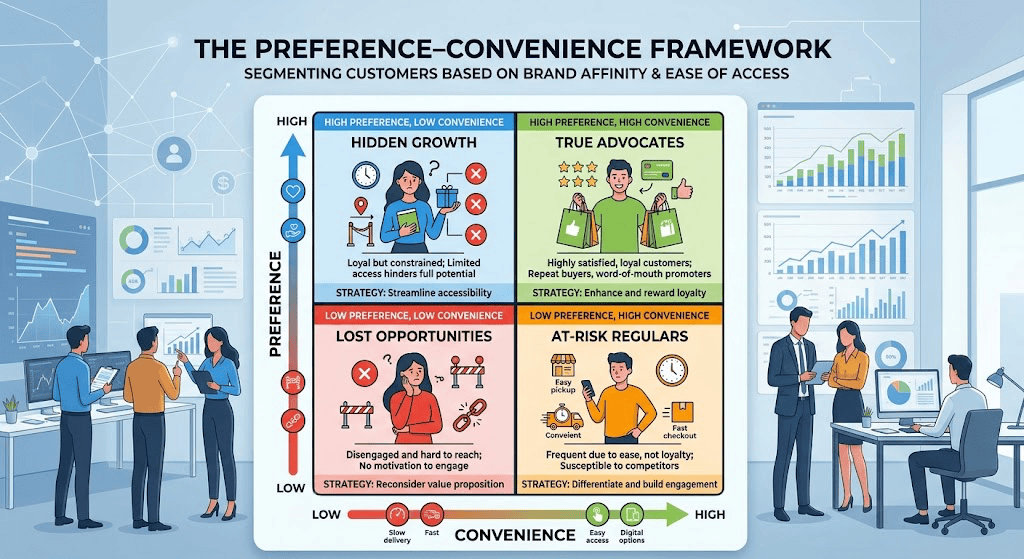
The Preference–Convenience Framework
Evaluating customer relationships beyond transactional data requires assessing two core dimensions: whether customers genuinely prefer you over alternatives, and how frictionless it is for them to buy again. This creates four distinct categories:
- High Preference, High Convenience (True Advocates): These customers value brand equity and face minimal friction accessing it. They represent your most profitable relationships, marked by lower price sensitivity, organic word-of-mouth, and high customer lifetime value (CLTV).
- High Preference, Low Convenience (Hidden Growth): These customers favor the brand but face distribution barriers or high switching effort. The objective here is operational scaling, channel expansion, and friction reduction.
- Low Preference, High Convenience (At-Risk Regulars): These customers buy out of proximity or habit. They look healthy in CRM databases, but retention is fragile. To migrate them into True Advocates, brand managers must deploy concrete value levers, such as signature proprietary features, exclusive loyalty privileges, and personalized onboarding, so customers choose you even when convenience is equalized.
- Low Preference, Low Convenience (Lost Opportunities): These prospects have no emotional connection to the brand and face high friction to buy. They require fundamental value-proposition redesign before deploying marketing capital.
The goal of brand strategy is not merely moving customers into the repeat-purchase column, but migrating them from convenience-driven behavior into preference-driven choice.
Diagnosing Revenue Quality
Relying solely on Repeat Purchase Rate (RPR) or Churn Rate creates a massive strategic blind spot. An enterprise software provider might boast a 92% retention rate, but if driven by multi-year contracts and painful data migration, it reflects vendor lock-in, often paired with a low Net Promoter Score (NPS). True preference directly lifts enterprise valuation by compressing Cost of Customer Acquisition (COCA) payback periods and driving Net Revenue Retention (NRR). This manifests when high retention pairs with a strong NPS, dominant Share of Wallet (SoW), high price elasticity resilience, and an organic referral engine.
Beyond Consumer Retail: The B2B Context
The Preference–Convenience divide is equally critical in B2B environments, where high switching costs frequently mask low product preference. A company may retain a legacy ERP system simply because switching platforms is too costly, the hallmark of B2B Inertia. The strategic vulnerability lies in relying on contractual switching friction rather than true solution reliance. When a modern competitor introduces a seamless migration tool that removes that switching friction, the legacy incumbent experiences catastrophic customer loss. B2B leaders win by pairing operational convenience (integration ease, responsive account management) with deep brand preference (proven ROI, strategic trust).
The Three Drivers of Sustainable Growth
Sustainable growth requires strategizing three synchronized pillars:
- Preference (Reason to Choose): Brands cannot rely on functional parity. Preference stems from recipe authenticity, nostalgic connection, or consistent quality. In my case, that shop in Opus does not merely serve food; it recreates an experience connected to Taipei that Chiqui and I value for under ₱1,000.
- Convenience (Frictionless Choice): Convenience drives habitual repeat behavior through accessible locations, digital ordering, and seamless payment pathways. Reducing effort builds habit, but convenience alone must not be mistaken for brand equity.
- Consistency (Delivering Trust): Preference brings customers in, convenience brings them back, and consistency converts trial into long-term confidence. A single brilliant experience creates initial interest; repeated consistency builds durable trust.
Remove any single factor and growth weakens. A brand with high preference but no convenience is admired but rarely bought. A brand with convenience but no preference is easily replaced. A brand with both but inconsistent execution eventually destroys trust. When repeat purchases become genuine loyalty, marketers create one of the most valuable business assets: customers who not only return, but recommend.
The Revenue Quality Audit
To help board and leadership teams evaluate whether their revenue reflects true brand equity or vulnerable inertia, organizations should audit their business against five summary diagnostic questions:
- Defensibility: If a well-funded competitor matched our price, location, and convenience tomorrow, what percentage of our customer base would actively choose to stay?
- Lock-In vs. Reliance: What proportion of our net revenue retention is sustained by high switching costs and contractual friction rather than active product preference?
- Organic Acquisition: What percentage of our new customer growth is driven by organic referrals that compress Customer Acquisition Cost payback periods?
- Value Levers: What concrete programs and R&D/innovation capital are allocated to migrate ‘At-Risk Regulars’ away from transactional habit and into ‘True Advocates’?
- Pricing Power: How resilient is our customer retention during price adjustments relative to competitors in our category?
The Executive Leadership Test
Every leadership team must ultimately ask: “If a competitor matched our price, location, and convenience tomorrow, would our customers still choose us?”
If the answer is no, the company possesses temporary dependence on circumstances, not brand loyalty. Convenience creates transactions; preference creates resilience. Competitors can match promotions, distribution channels, or apps, but they cannot easily duplicate years of trust, emotional connection, and brand preference.
Looking back at our visits to that restaurant in Opus, convenience introduced us to the shop, but preference keeps us coming back, even as I continue to figure out where habitual taste ends and true brand loyalty begins.
***
Josiah Go is a bestselling author, award-winning business educator, and independent director of a universal bank.
Josiah will lead the 2nd Strategy Logic Chain 1-Day Masterclass in Ortigas on October 22, 2026. He will also speak in the 3rd Strategic Marketing Plan Conference (The Marketing Audit) on Sept 22-23, 2026 (1:30-5:15pm) via Zoom. Email info@mansmith.net for details.