

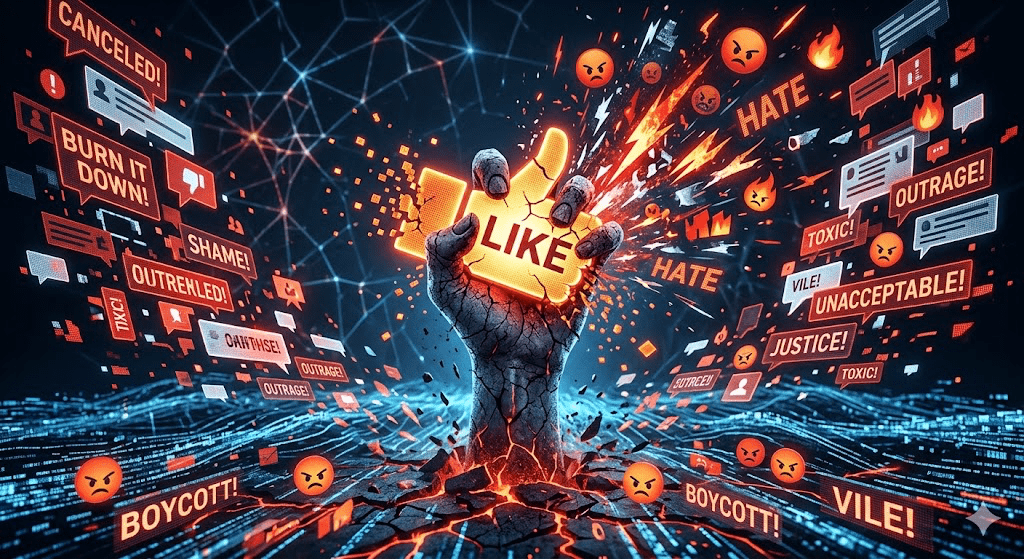
A post does not need to be controversial to produce a real-world effect.
I recently shared about a new restaurant I had tried, just a simple observation and a casual encouragement for people to visit early. There was no agenda behind it, nothing beyond a personal experience.
The next day, it had become a full house. Customers were arriving earlier than usual, apparently influenced by what they had read online. It was a small moment, but a revealing one. A single post had moved beyond communication and into coordination, quietly shaping behavior in ways no one fully intended or controlled.
That same dynamic rarely stays harmless for long.
Social media has given us scale, speed, and visibility. It has also changed how communication functions in practice.
Messages rarely stay as messages. They become events. And events rarely remain proportional to intent.
What complicates this environment is not just reach, but distortion. The reaction is often larger than the message itself, and at times no longer directed at the message at all.
When Messages Become Symbols
Online anger rarely stays attached to ideas. It attaches to people, and then to what those people are believed to represent.
A statement can become a symbol. A person can become a proxy, for authority, elitism, politics, or “the system.” Once this shift happens, the original meaning begins to fade. What remains is interpretation shaped more by identity than by content.
In that state, clarification becomes less effective. Responses are directed not only at what was said, but at what is assumed to be behind it.
Why Behavior Changes Online
Digital spaces alter behavior in ways that are not always visible in real time.
Without tone, presence, or immediate consequence, restraint weakens.
Expression becomes faster and less filtered than it would be in face-to-face interaction.
Moral framing adds another layer. Hostility is often not perceived as hostility. It is reframed as correction, honesty, or accountability.
In group settings, responsibility diffuses. As participation increases, individual restraint tends to decrease. What would feel excessive alone can feel acceptable in a crowd.
Over time, the reaction changes shape.
When Scale Becomes Proof
Online outrage often carries a sense of certainty. People believe they are correcting something wrong, and in some cases, they are.
But scale introduces distortion. As voices converge, volume can begin to resemble validation. Size gets mistaken for substance.
At that point, participation often replaces reflection. Being part of the reaction becomes more immediate than evaluating it.
This is not incidental. It is reinforced by the structure of the platforms where these reactions occur.
The System That Rewards Emotion
Social platforms are designed around engagement, and engagement is rarely neutral. Emotion spreads faster than nuance, and certainty spreads faster than doubt.
Over time, expression adjusts to this environment. Language becomes sharper. Positions become more fixed. Not necessarily because beliefs have deepened, but because the system favors what travels.
Outrage, in this sense, is not only emotional. It is reinforced.
As reactions become collective, they gain momentum. People mirror what they see. Silence begins to signal distance, while participation signals alignment.
Escalation becomes self-reinforcing.
Still, most digital storms are temporary. Attention shifts. Energy disperses. What feels overwhelming in the moment often loses intensity with time.
Structure explains much of the behavior. Not all of it.
Displaced Emotion
Some reactions carry more than the trigger itself.
Frustration, pressure, and unresolved tension often look for an outlet. A visible person or event becomes that outlet. The response, then, is shaped not only by what happened, but by what was already present.
This does not justify the behavior. It explains the imbalance.
At times, the intensity of reaction reflects less the subject itself, and more the weight behind it.
When to Respond
Understanding the pattern changes how response functions.
The instinct to respond is natural. Silence can be interpreted in different ways. But response is not neutral. It extends attention, and attention sustains momentum.
Audiences are not uniform. Some are fixed in position, some are observing, and some remain open. Treating them as a single group often leads to unnecessary escalation.
In that sense, response without discernment can reinforce the very dynamic it is trying to manage.
Restraint, in certain situations, is not absence. It is containment.
What This Pattern Shows
Online outrage is unlikely to disappear. It is embedded in how attention now moves.
Seen clearly, it becomes less personal and more structural. Less like judgment, and more like pattern.
Patterns are easier to navigate than unstructured reaction.
What feels like a personal response is often a reflection of the system it passed through.
Once understood this way, volume loses some of its authority, and attention becomes easier to interpret.
***
Josiah Go is a business thought leader, bestselling author of 20 books in marketing and entrepreneurship, and the chair of Mansmith and Fielders Inc.
