
After more than 30 years of advising business owners, leadership teams, and organizations, one pattern remains remarkably consistent: strategies rarely fail because of execution. We like to blame execution because it is a visible, actionable scapegoat. It suggests the team simply lacked the “hustle” or the incentives weren’t sharp enough. But the truth is more structural.
Strategies fail because of unverified assumptions, invisible pillars embedded in decisions that were never explicitly tested or governed. This is not a theoretical debate; it is a fundamental flaw in the way we build organizations.
To understand it properly, we must distinguish between two layers of the mental stack: the reasoning architecture and the governance mechanism.
For those who have followed my work on the PILA reasoning sequence (Problem, Insight, Logic, Assumptions), you know that assumptions sit at the very base of our strategic stack. It is the layer that determines whether the entire strategy is a solid bridge or a dangerous hallucination. But while PILA is how we form a decision, we need a second discipline for how we govern it. This is where DETOX comes in. If PILA is the blueprint for the bridge, DETOX (which I will detail below) is the structural load test. It is the formal governance mechanism that ensures assumptions are surfaced and managed in real-time decision-making.
When both are missing, organizations optimize the roof of a house while the foundation is being eaten by termites.
The Structural Problem: Governing the Visible
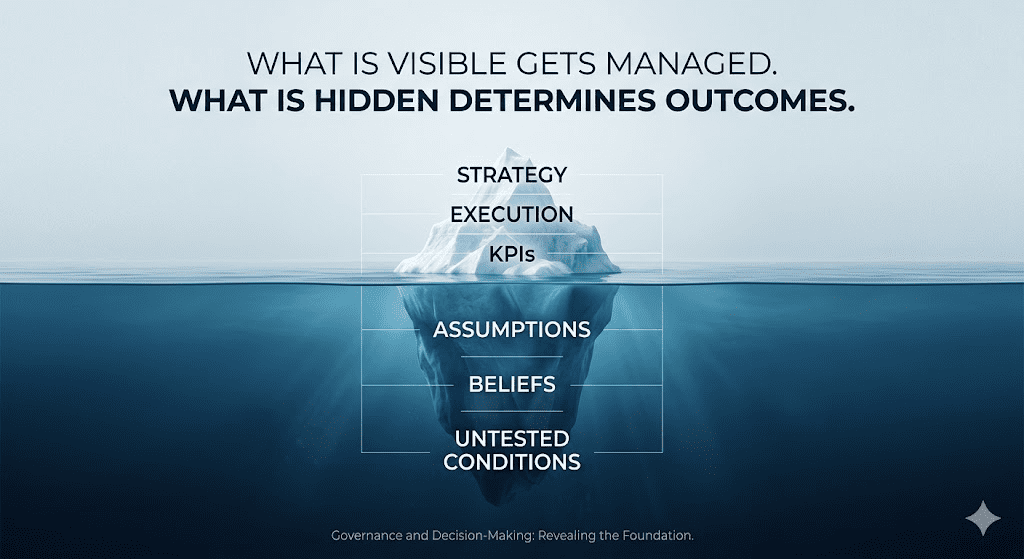
Most organizations treat “the plan” as the primary unit of control. We review progress reports, audit budgets, and track milestones. But a plan is just an output. It is the tip of the iceberg.
Beneath the waterline lies the massive, unseen weight of the beliefs that make the plan possible.
In a typical decision cycle, a proposal moves through a predictable path: it is drafted, debated for its “logical flow,” and eventually approved for funding.
However, the governance is almost always focused on the “what” and the “how.” The “why it should work”, the underlying conditions that make the logic valid, is rarely invited to the table.
We govern the decision, but we ignore the ingredients. This creates a structural gap where assumptions remain embedded in the strategy narrative but invisible to oversight. We are managing outcomes, but not the underlying conditions that determine whether those outcomes are valid.
Where Foundations Live: The PILA Perspective
Within the PILA reasoning architecture, assumptions sit at the foundation layer. They are not conclusions, and they are not even logic. They are the base conditions. They are the “pre-understandings” that define whether our reasoning, modeling, and strategy are valid in the first place.
Everything above this layer depends on its stability. When assumptions are weak, outdated, or untested, every layer built on top, no matter how brilliantly executed, inherits that fragility. This is why strategic failure is often discovered late; it originates early, at the level that is least examined. The delay between the formation of an assumption and its eventual failure is what creates systemic risk. During that delay, assumptions feel like certainty, and organizations act accordingly.
Why Foundations Remain Hidden
Why are assumptions rarely surfaced clearly? It is often due to the culture of “perceived competence.” In most professional environments, certainty is rewarded more than clarity of uncertainty. We have been trained to believe that a leader must speak with absolute conviction to be respected.
When a person expresses a doubt or points out an untested assumption, it is often interpreted as a lack of alignment or a sign of weakness. Consequently, teams instinctively scrub their presentations of “ifs” and “maybes.”
Assumptions are gradually absorbed into the narrative until they are no longer visible as separate inputs. By the time decisions reach approval, they are no longer visible as bets; they are presented as facts. But a fact is a truth proven in the past; an assumption is a bet placed on the future. Confusing the two is the shortest path to a crisis.
When Foundations Break: The Cost of Familiarity
The most dangerous assumptions are not the unknown ones; they are the familiar ones.
Success is a powerful anesthetic. It makes us believe that what worked in the last decade is a permanent law of nature. We replace active validation with passive familiarity.
Consider the recent shifts in how we work. For decades, the dominant assumption was that “work requires a shared physical space for culture to exist.” Entire industries were built on this single pillar. When the environment shifted, that pillar didn’t just crack; it vanished. The organizations that suffered most weren’t the ones with “bad execution.” They were the ones whose “execution excellence” was tied to a world that no longer existed.
In both retail and real estate, failure did not come from a lack of capability. It came from assumptions that were never required to prove themselves under changing conditions. Experience converted past success into perceived permanence. This is how organizations accumulate risk without recognizing it, not through isolated mistakes, but through the repeated execution of untested logic.
DETOX: The Governance Discipline for Assumptions
To address this structural gap, assumptions must be treated as governed inputs within decision-making, not invisible background noise. This requires a formal discipline: DETOX.
D — Design for Future Failure
Assume some strategic beliefs will not hold. Build flexibility into your capital allocation and execution design so the failure of a single assumption does not become a systemic failure.
E — Explicit Assumptions
If an assumption is not written, it is not governed. Every strategy should be accompanied by a clear list of the “Leaps of Faith” it depends on. Making them explicit is part of corporate transparency.
T — Time-test Assumptions
The world moves faster than our planning cycles. Every assumption must be stress-tested against a multi-year horizon. The key question is not whether it works today, but whether it survives structural change over time.
O — Open to Dissent
Fast agreement is not validation; it is often just exhaustion. Structured disagreement must be embedded into the process to surface weak pillars early. Reward the person who finds the crack in the foundation while the cost of repair is still low.
X — eXpose Assumptions Objectively
Assumptions must be treated as hypotheses, not positions. Their purpose is validation under pressure, not defense under discussion. We aren’t testing the person; we are testing the assumptions.
The Leadership Test: Integrity of the Foundation
Respecting the PILA sequence and the DETOX discipline is ultimately a test of character. It requires a leader who is humble enough to admit they don’t have all the answers yet. It requires a culture of transparency where it is safe to say that the logic feels shaky. These statements create tension and delay the “rush,” but they are the hallmarks of a leader who is truly being careful.
Execution consistency only creates value when the underlying assumptions remain valid. When the world changes but execution remains consistent, you don’t become efficient, you become increasingly misaligned at scale.
Consistency without valid assumptions does not create stability; it accelerates your exposure to disaster.
The Closing Implication
Every strategy works, until its assumptions stop working. By the time those foundations fail, decisions have already been made, capital has been deployed, and structures have been built. At that point, you are no longer designing a strategy; you are correcting a catastrophe under constraint.
As you look at your next big move, don’t just ask if the team can execute. Ask what you are assuming to be true. Pull those invisible pillars out into the light. Respect the friction. It is the only thing keeping you on the road.
***
Josiah Go is a business thought leader, bestselling author of 20 books in marketing and entrepreneurship, and the chair of Mansmith and Fielders Inc. He is the co-creator (with Chiqui Escareal-Go) of the PILA Framework and the Trust Economy Flywheel.