
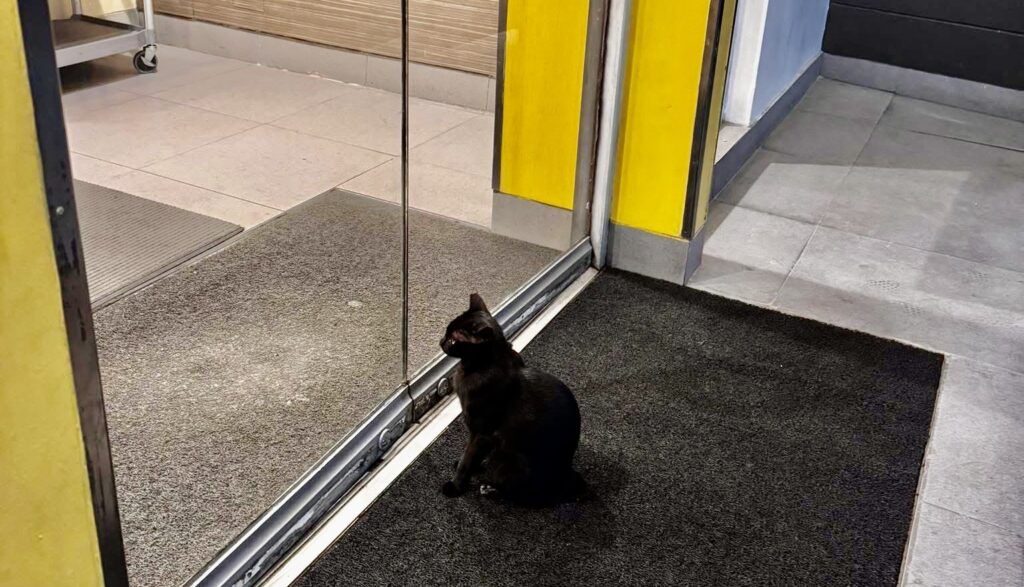
Outside a Jollibee in Green Meadows, I once watched a stray cat that understood leverage.
Customers came and went. The glass door opened repeatedly. The cat did not move. It was not distracted by motion; it was assessing asymmetry. It looked for the specific moment when a patron with a large tray and a slow gait would struggle with the door, the point where effort was lowest and reward was highest. In the end, it never entered. That is timing.
Strategic timing is the discipline of committing capital and capability only when time improves your structural odds. Speed is often mistaken for advantage. But being first to move is not the same as being first to win. The question for a leader is not “Should we act?” but: what is time doing to our position—strengthening it or weakening it?
The Greeks distinguished between Chronos, the passage of time, and Kairos, the decisive moment. Most organizations manage Chronos. Few are disciplined enough to wait for Kairos, the window where logic and opportunity align.
Real firms operate across multiple quadrants simultaneously, and timing signals often lag underlying structural shifts. The matrix is not a description of the entire firm, but a diagnostic lens for specific strategic bets.
The Strategic Timing Matrix
To operationalize timing, evaluate two variables: Structural Advantage (is time helping or hurting?) and Irreversibility of Commitment (how costly is it to undo?).
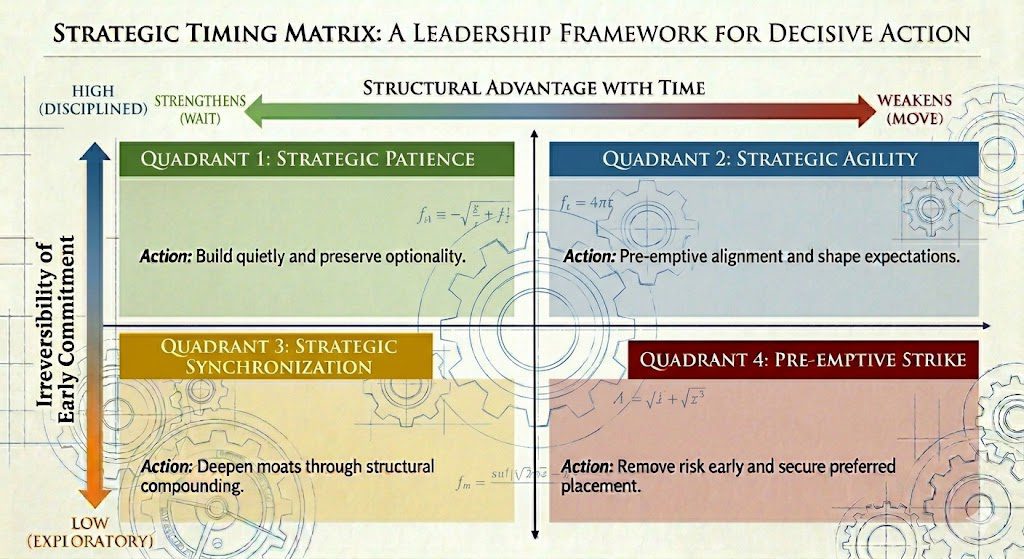
Quadrant 1: Strategic Patience
(High irreversibility, time strengthens)
Strategic Patience is not inertia. Inertia is drift; Strategic Patience is the active management of latent potential. It is the disciplined delay of irreversible scale while capability compounds.
GCash provides the blueprint. In the early 2000s, the assumptions for aggressive scaling were fragile: low smartphone penetration, expensive data, and thin merchant acceptance. Scaling prematurely would have meant deploying capital into an immature ecosystem.
Instead, it built quietly—strengthening partnerships, compliance, and distribution. When the pandemic compressed years of digital adoption into months, it did not need to reposition. It was already there.
When time strengthens your assumptions, scale compounds returns rather than diluting them.
Quadrant 2: Strategic Agility
(High irreversibility, time weakens)
Not all environments reward patience. When regulatory frameworks crystallize or platforms standardize, waiting becomes a form of erosion.
Agility is not indecision. It is the definitive move made when the cost of waiting exceeds the risk of acting.
Consider early signaling around a potential 2028 presidential run in the Philippines by Sara Duterte. In a fluid political landscape, early positioning shapes expectations before structures harden.
In these cases, acting under uncertainty is safer than waiting for clarity that only arrives after the window has closed.
Quadrant 3: Strategic Synchronization
(Low irreversibility, time strengthens)
Here, advantage compounds through structure rather than singular moves.
SM Investments Corporation illustrates this well. Property, retail, and banking reinforce one another. A mall increases foot traffic; foot traffic deepens financial relationships; financial data sharpens property decisions.
In this quadrant, consistency is the weapon. The goal is not disruption, but reinforcement, tightening integration until the system becomes difficult to replicate.
Large conglomerates succeed not because of isolated brilliance, but because their parts begin to compound each other. Their advantage isn’t just their processes, it is the accumulated trust of their ecosystem.
Quadrant 4: Pre-emptive Strike
(Low irreversibility, time weakens)
When downside is contained and opportunity is visible, hesitation transfers advantage to rivals. This is the zone of speed.
When Gardenia entered the market with a daily pull-out policy, it reduced retailer risk before competitors could respond. Shelf space was secured not through negotiation, but timing.
Pre-emptive action is justified when waiting costs more than acting, provided the bet remains reversible.
The Discipline of Stillness
The stray cat outside Jollibee did not react to every open door. It understood that motion is not progress. It waited for asymmetry, that rare moment when odds shift decisively. When that moment did not fully arrive, it held its ground. That stillness was not hesitation; it was judgment.
Most organizations are designed for motion. We reward doing and distrust waiting. But in capital allocation, the highest form of action is often restraint, the decision to hold until time improves the structure of opportunity.
When time strengthens you, wait. When time weakens you, move. And when commitment is irreversible, be certain that time is on your side.
Timing is not about motion.
It is about disciplined leverage.
***
Josiah Go is chair of Mansmith and Fielders Inc.
