

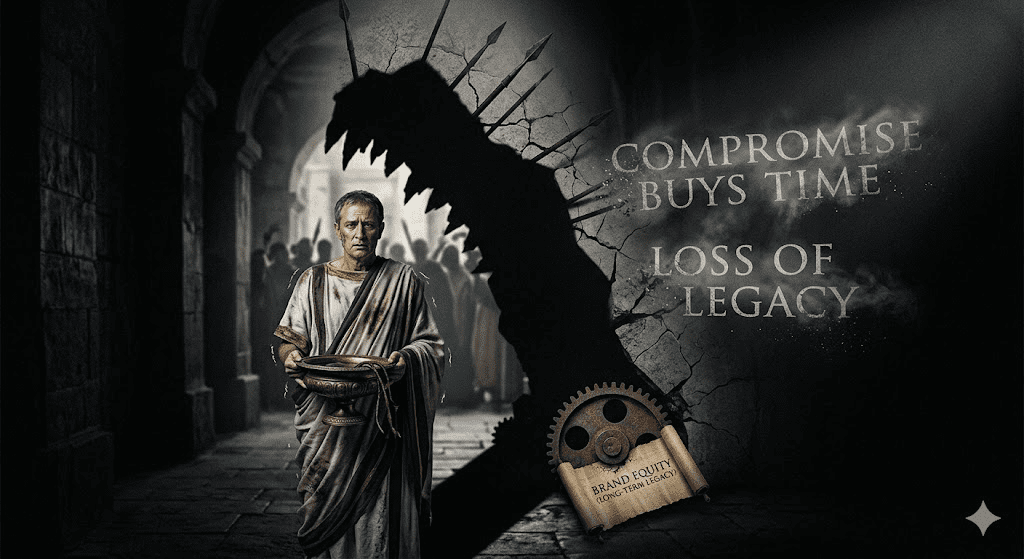
Last Good Friday, we analyzed Pontius Pilate as the “regional managing director” of moral cowardice. He correctly identified the truth but failed the test of strategic courage. The feedback to that analysis was illuminating: readers appreciated the bridge between biblical narratives and organizational leadership, without the tone being “preachy.”
This reflects a market-driving approach to sharing knowledge, one that moves away from traditional lectures and toward strategic reflections that encourage leaders to audit their own “decision architecture.” It seems that my eight years in theology school, decades ago, did not go to waste.
In this second part, we take a deeper look at Pilate’s failure. It was not just a single moment of cowardice; it was a tactical breakdown rooted in the belief that a “partial sacrifice” can appease an aggressive environment. Pilate did not just wash his hands, he tried to negotiate.
Through a PILA (Problem, Insight, Logic, Assumption) decode, we see how this incremental compromise became a resource leak that ultimately cost him his authority.
1. Problem (P): Equilibrium vs. Justice
Pilate defined his problem as a resource allocation issue. He had one prisoner (the Truth) and one hostile environment (pressure from the crowd). He wanted to satisfy external demand while keeping his record clean. He was not solving for justice; he was solving for equilibrium.
2. Insight (I): The Illusion of the Threshold
Pilate’s “insight” was that the crowd was rational. This is captured in Luke 23:16, where he attempts his first tactical compromise: “Therefore, I will punish him and then release him.”
He believed there was a saturation point, a level of punishment at which the crowd would see a beaten man and say, “That is enough.” He viewed the scourging (whipping) as a strategic trade-off: spending the capital of physical punishment to “buy back” the prisoner’s life.
3. Logic (L): The Escalation Ladder
His logic followed a step-ladder of tactical retreats:
- Step 1: Declare innocence and hope for a quiet exit. (Failed)
- Step 2: Jurisdictional handoff to Herod. (Failed)
- Step 3: Inflict severe physical punishment as a “middle ground.” (Failed)
- Step 4: Offer a prisoner swap (Barabbas) to shift accountability. (Failed)
He believed that by presenting a broken man, he could satisfy the demand for blood without fulfilling the demand for death.
4. Assumptions (A): The Sequential Collapse
This is where the strategy fell into a sunk cost spiral. Pilate’s assumptions failed one after another:
- Assumption 1: Punishment buys mercy.
When you yield to pressure, you do not satisfy it, you amplify it. The sight of blood did not evoke pity; it signaled Pilate’s weakness. - Assumption 2: A partial sacrifice protects the core.
You cannot “half-kill” the truth. By allowing the whipping, Pilate committed a fiduciary breach. He devalued Roman justice by showing that the law was negotiable. Pilate lost his moral high ground; he was no longer a judge, but an accomplice. - Assumption 3: Compromise buys time.
The most expensive thing a leader can buy is “a little more time.” Pilate bought an hour of whipping but paid for it with his legacy. As noted in John 19:12, the delay only allowed the pressure to refine its leverage:
“From then on, Pilate tried to set Jesus free, but the Jewish leaders kept shouting, ‘If you let this man go, you are no friend of Caesar…'”
The Strategic Takeaway: Short-Term KPI vs. Long-Term Brand
The Pilate Trap is a warning for every leader who believes disruption can be managed through incremental capitulation. Many assume they can appease a toxic culture or a hostile stakeholder by punishing an outlier “just enough” to make the noise stop.
But a half-measure is often more expensive than a full measure. It signals hesitation without resolving the conflict.
Pilate thought he was protecting his career (the short-term KPI), but he permanently damaged his brand equity (his long-term legacy).
By the time he washed his hands, there was nothing left of his leadership worth saving. He did not buy peace, he bought a resource leak that drained his authority until his reputation was as compromised as the justice he failed to uphold.
Reflections
- Are you solving for objective truth or temporary equilibrium?
- Is your strategy just a series of tactical retreats?
- Are you sacrificing your brand equity to hit a short-term KPI?
For further reading on PILA, see:
https://josiahgo.com/pila-why-integrated-thinking-wins-where-individual-skills-fail/
