

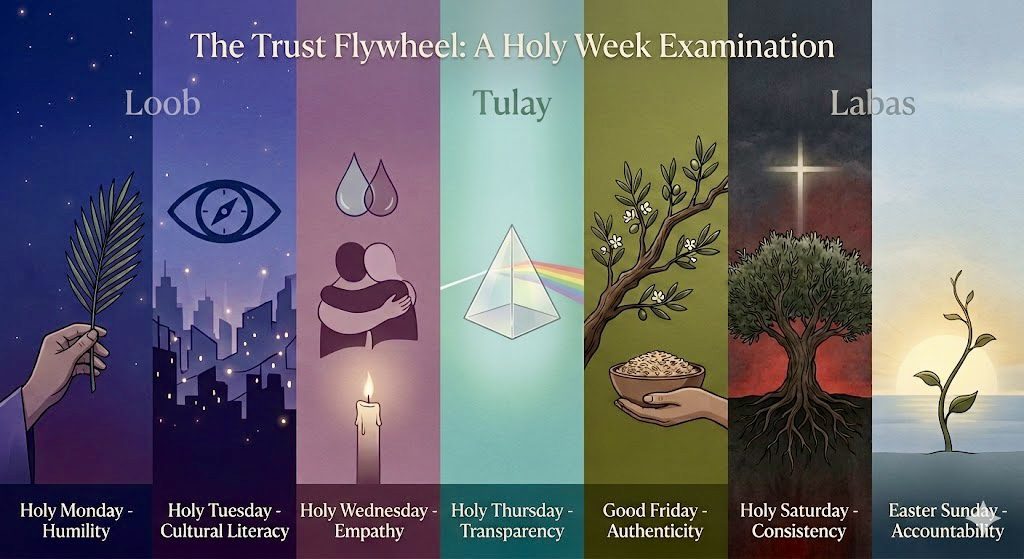
In business, trust is an asset we work hard to protect. But Holy Week confronts us with something harder: trust is, first, a truth we must face, about who we are when no one is measuring, tracking, or watching.
Holy Week does not let us stay comfortable. It asks the question every leader eventually has to face: is who I am inside consistent with what I show outside?
A Personal Note
This reflection is not purely professional. Josiah spent eight years studying theology, discerning a pastoral calling, before arriving at a single, firm realization: his work is his ministry.
Strategy, leadership, marketing — none of it is neutral. In the right hands, with a rightly ordered interior, these become instruments of service, accountable not just to the market, but to something higher.
That conviction is what the Trust Flywheel is built on. Not as a framework to deploy, but as a way of life to return to — in organizations, in relationships, at home.
On Humility
Trust does not begin with competence. It begins with surrender.
“He humbled himself by becoming obedient to death, even death on a cross.” (Philippians 2:8)
We spend so much of our leadership lives projecting confidence — building the case for why we should be trusted.
But Holy Week begins with a very different posture. A leader who washes feet. A teacher who enters the city not on a warhorse but on a donkey. Humility is not weakness performing modesty. It is strength choosing to make room — for truth, for others, for what is actually real.
In our Loob, our inner life, this is where trust starts. Not in the boardroom. In the question we ask ourselves before we walk in: Am I here to serve, or to be seen?
On Cultural Literacy
Every community has its unspoken rules. Its fears. Its hopes. The things people will never say in a meeting but carry into every one.
“Do not conform to the pattern of this world, but be transformed by the renewing of your mind.” (Romans 12:2)
Cultural literacy is the discipline of paying attention — not to confirm what we already believe, but to genuinely understand. Not all norms deserve to be kept. Some protect dignity. Others protect comfort, tradition, or ego. The leader who cannot tell the difference will always be managing perception, never building trust.
On Empathy
There is a kind of empathy that observes from a safe distance — that says I understand without ever really entering in.
“Rejoice with those who rejoice; mourn with those who mourn.” (Romans 12:15)
Holy Week is not a week for safe distance. It is a week that asks us to stay — in the garden, through the silence of Holy Saturday, without rushing to the resolution we know is coming. The leader who can do that — who can be present without fixing, who can witness without managing — builds a different kind of trust. The kind that holds when things are hardest.
On Transparency
What is true inside must eventually cross into relationships. It cannot stay hidden indefinitely.
“There is nothing hidden that will not be disclosed, nothing concealed that will not be known.” (Luke 8:17)
Transparency is not oversharing. It is refusing to hide what matters — to ourselves, to those we lead, to the mission we have been given. And it is not only a moral posture. Opacity is a governance risk. What leaders conceal, organizations eventually absorb — in confusion, in suspicion, in slow disengagement.
Tulay — the bridge — is built from this. What we are inside must find its way outward, or trust never fully forms.
On Authenticity
“By their fruit you will recognize them.” (Matthew 7:16)
Authenticity is not a personal brand. It is not curated vulnerability or a well-crafted origin story. It is simply the alignment between what we say and how we live — sustained not in the moments when it is easy, but in the ones when it costs something.
Holy Week is full of people who were tested on exactly this. Some held. Some did not. Most were somewhere in between — which is, if we are honest, where most of us are too.
On Consistency
“Let us not grow weary in doing good, for at the proper time we will reap a harvest if we do not give up.” (Galatians 6:9)
Trust is not built in grand gestures. It is built in the repeated, ordinary choice to do what we said we would do — even when no one is watching, even when the return is not immediate, even when the effort feels disproportionate to the result.
This is the Labas — the outer life — made credible. Not by announcing our values, but by living them long enough that others stop questioning whether we mean it.
On Accountability
“Each of us will give an account of ourselves to God.” (Romans 14:12)
Accountability is the hardest part of the flywheel — because it requires us to own what went wrong without retreating into explanation. In organizations, we have become very skilled at explaining. Accountability is different. It is repair. It is the choice to face what broke and to do the work of restoring it.
The Resurrection does not erase the cross. It redeems it. That is what accountability, at its best, offers — not the erasure of failure, but its transformation into something that renews trust rather than ending it.
In Part 2, we bring these reflections into the days of Holy Week themselves — a day-by-day guide for leaders who want to move from insight to intentional action.